
Last Updated on November 23, 2026
The 30-Second Answer: the most useful saucepan size for most kitchens is 3 quarts. Pair it with a small 1 to 2-quart pan for sauces and a 4-quart pan for bigger batches.
- 1 to 1.5 quarts: melting butter, warming milk, small sauces for 1 or 2.
- 2 to 3 quarts: rice, oatmeal, grains, eggs and soup for 2 to 4. The everyday size.
- 4 quarts and up: pasta for a few people, potatoes and family soups.
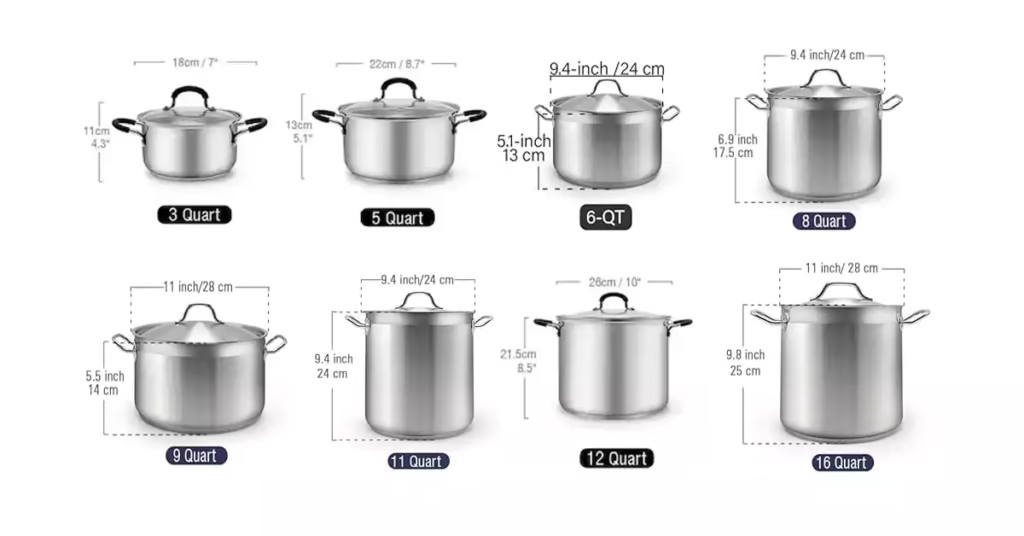
A 3-quart saucepan is usually about 8 inches wide. See the full saucepan sizes chart.
A note on this guide: The sizes and capacities in this guide come from manufacturer specs and standard cookware sizing. Our team is testing saucepans in The Kitchenware Journal lab, and we will add our hands-on results and photos soon.
Saucepans are sold by volume in quarts, from tiny 1-quart pans to 4-quart and larger. Choosing the right saucepan size means faster heating, less scorching and fewer spills over.
This saucepan sizes guide shows what each size is for, how many people it serves, typical diameters and metric equivalents, plus our pick for each size.
In this guide
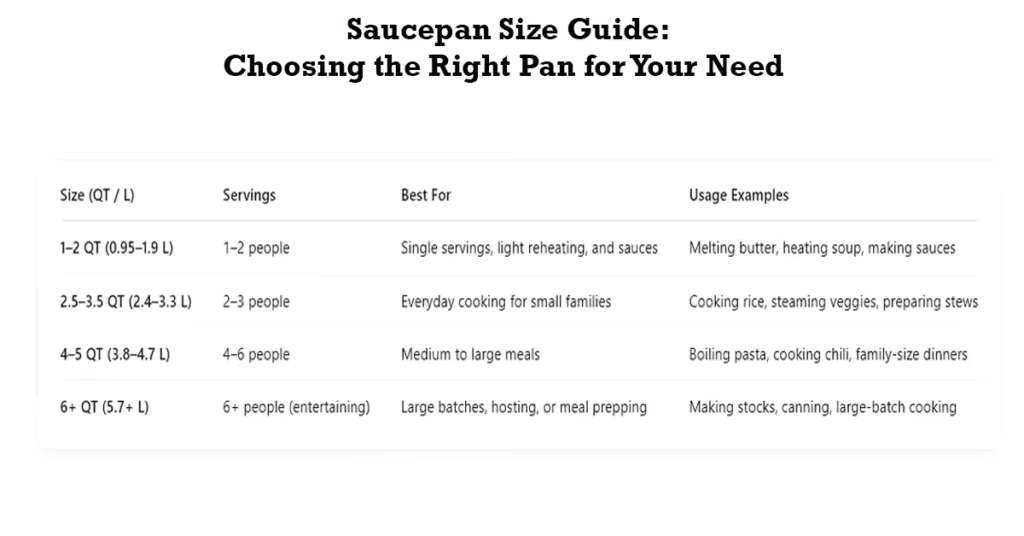
Saucepan Sizes Chart
| Size | Liters | Typical diameter | Servings | Best for |
|---|---|---|---|---|
| 1 quart | About 0.95 L | About 6 in (15 cm) | 1 | Butter, small sauces, warming milk |
| 1.5 quarts | About 1.4 L | About 6 to 7 in (16 cm) | 1 to 2 | Oatmeal, gravy, reheating |
| 2 quarts | About 1.9 L | About 7 in (18 cm) | 2 to 3 | Rice, grains, boiled eggs, soup for 2 |
| 3 quarts | About 2.8 L | About 8 in (20 cm) | 3 to 4 | The all-rounder: rice, soup, vegetables |
| 4 quarts | About 3.8 L | About 8 to 9 in (20 to 22 cm) | 4 or more | Pasta for a few, potatoes, family soup |
| 5+ quarts | 4.7 L or more | 9 in and up | Family size | Usually sold as a small stock pot or Dutch oven |
Diameters vary by brand and wall height. A taller pan holds more at the same width.
What Size Saucepan Do I Need?
- Cooking for one: a 1.5-quart and a 2-quart saucepan cover most meals.
- Couples: 2-quart and 3-quart saucepans.
- Families of 4 or more: 2-quart, 3-quart and 4-quart saucepans, plus a stock pot.
- Buying just one: a 3-quart saucepan with a lid.
Fill a saucepan no more than about two-thirds full when boiling, so it does not boil over. For big batches, step up to a 2-gallon stock pot.
Saucepan Sizes for Common Tasks
| Task | Recommended size |
|---|---|
| Melting butter or chocolate | 1 quart |
| 1 cup dry rice (about 3 cups cooked) | 2 quarts |
| Oatmeal for 2 | 1.5 to 2 quarts |
| Boiling 6 eggs | 2 to 3 quarts |
| Steaming vegetables with an insert | 3 quarts |
| Soup for 4 | 3 to 4 quarts |
| Half a pound of pasta | 4 quarts or a pasta pot |
Best Saucepan for Each Size
1. KC-Emier 1-Quart Tri-Ply Stainless Saucepan (Best 1-Quart)
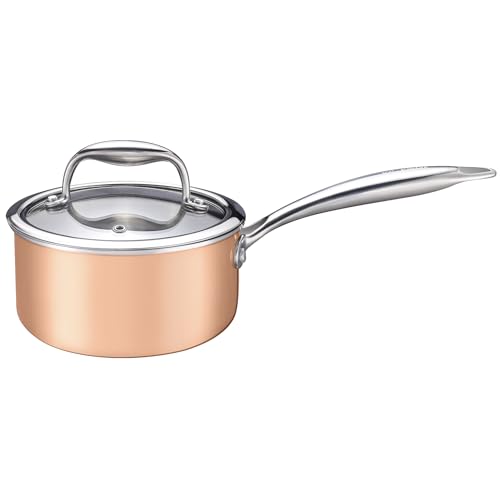
A small tri-ply stainless saucepan with a lid, sized for butter, sauces and single servings.
Why We Like It
Tri-ply construction heats evenly, so small amounts of milk or sauce are less likely to scorch.
Flaws to Know
- Too small for grains for two
- Lesser-known brand
Buy it if: you often cook small amounts. Skip it if: you cook for a family.
2. Cuisinart Chef’s Classic 2-Quart Saucepan (Best Budget 2-Quart)

Cuisinart’s Chef’s Classic 2-quart saucepan is stainless steel with an aluminum-encapsulated base and a lid.
Why We Like It
Affordable, durable and dishwasher safe, and the right size for rice and oatmeal.
Flaws to Know
- Base-only heating
- Handle can get warm
Buy it if: you want a budget everyday saucepan. Skip it if: you want fully clad construction.
3. Tramontina Signature Tri-Ply 2-Quart Saucepan (Best Clad 2-Quart)
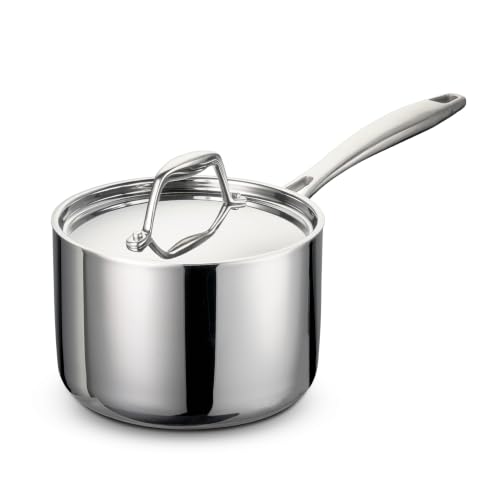
Tramontina’s Signature saucepan is tri-ply clad stainless steel all the way up the sides.
Why We Like It
Premium-style even heating at a modest price, and it works on induction.
Flaws to Know
- Needs oil or liquid to avoid sticking
- Heavier than budget pans
Buy it if: you want clad performance on a budget. Skip it if: you prefer nonstick.
4. Tramontina Signature Tri-Ply 3-Quart Saucepan (Best 3-Quart)
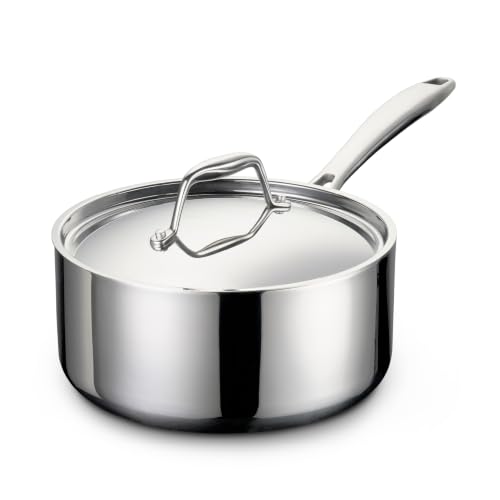
The 3-quart version of Tramontina’s tri-ply saucepan is the most versatile size in the kitchen.
Why We Like It
Big enough for soup for four, small enough for everyday rice and vegetables.
Flaws to Know
- No pour spouts
- Heavy when full
Buy it if: you want one do-everything saucepan. Skip it if: you mostly cook for one.
5. T-fal Revive Ceramic Nonstick 3-Quart Saucepan (Best Nonstick 3-Quart)
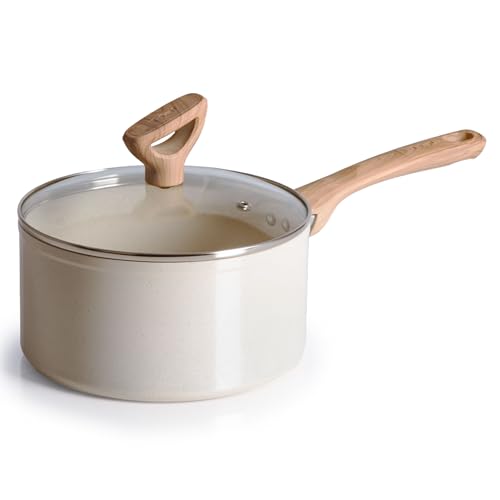
T-fal’s Revive saucepan has a ceramic nonstick interior, a lid and a forged body.
Why We Like It
Oatmeal, rice and milk-based sauces wipe out easily.
Flaws to Know
- Ceramic coatings wear sooner than stainless
- Hand wash recommended
Buy it if: you want easy cleanup. Skip it if: you want a lifetime pan.
6. Cuisinart MultiClad Pro 4-Quart Saucepan (Best 4-Quart)

Cuisinart’s MultiClad Pro 4-quart saucepan is tri-ply stainless with a lid.
Why We Like It
Large enough for potatoes, pasta for a few people and family soups, with even heat.
Flaws to Know
- Heavy when full
- Costs more than budget pans
Buy it if: you cook for a family. Skip it if: you have a small household.
Want to compare materials? Read what material is best for saucepans, or see budget saucepans, milk saucepans and lightweight saucepans for weak wrists.
How to Measure a Saucepan’s Size
- Volume: fill the pan to the brim with water using a measuring cup. Four cups make 1 quart.
- Diameter: measure across the top from inside edge to inside edge.
- Check the base: many brands stamp the size on the bottom.
Keep pans in good shape with our guides on how to clean a saucepan. More on cookware types is in Wikipedia’s cookware article.
UK, Canada and EU Buyer Notes
- UK and Ireland: saucepans are sold by diameter. A 16 cm pan holds about 1.5 litres, 18 cm about 2 litres and 20 cm about 3 litres. A 20 cm saucepan is close to a US 3-quart pan.
- Canada: sizes are often given in quarts and litres; 1 quart is about 0.95 litres.
- Germany, France, Italy and Spain: search for Stieltopf or Kasserolle 18 cm (DE), casserole 18 cm (FR), casseruola 18 cm (IT) or cazo 18 cm (ES). European saucepans are usually listed by diameter and litres.
- Hob size: match the saucepan base to your hob ring, within about 2 cm, for efficient heating.
More Saucepan Guides
This page is our starting point for saucepan questions. When you need a specific answer, these guides go deeper:
- Enamel Saucepans: Benefits, Care and How to Choose
- Difference Between a Saucepan and a Skillet
- Saucepan vs Pot: What’s the Difference?
- Skillet vs Saucepan: Differences and Uses
- Double Boilers: How They Work and How to Choose One
Frequently Asked Questions
What is the most common saucepan size?
The 2-quart and 3-quart sizes are the most common. A 3-quart saucepan is the most versatile.
What size saucepan do I need for rice?
A 2-quart saucepan for 1 cup of dry rice, and a 3-quart for 2 cups.
How big is a 3-quart saucepan?
Usually about 8 inches (20 cm) across and about 4 inches deep, holding about 2.8 litres.
What size saucepan is best for one person?
A 1.5 to 2-quart saucepan covers most meals for one.
What is the difference between a saucepan and a pot?
A saucepan has one long handle and tall sides; a pot or stock pot is larger, with two short handles.

Reviewed by Samantha Hickel, Kitchenware Reviewer & Cookware Expert. Samantha has cooked for more than ten years, has reviewed kitchenware for The Kitchenware Journal since 2022, and covers stock pots, saucepans, canning, cake and bread pans, cutting boards and everyday kitchen tools. Our lab tests kitchenware, cutting boards and serving pieces for capacity, durability, stain resistance and ease of care. How we test.
Related guides: Best Material for Saucepans · Best Budget Saucepans · Best Milk Saucepans · Types of Cookware