
Last Updated on November 15, 2026
The 30-Second Answer: this kitchen conversion chart covers the numbers you’ll look up most: 1 US cup = 16 tablespoons = 48 teaspoons = 8 fluid ounces = about 237 ml. 1 tablespoon = 3 teaspoons = about 15 ml, and 1 teaspoon = about 5 ml. Use the converter below for anything else.
- Liquids: convert by volume (cups, ml, fluid ounces).
- Flour, sugar and butter: convert by weight (grams), because a cup of flour and a cup of sugar weigh very different amounts.
- UK, Australian or older recipes: check which “cup” or “pint” they mean; they’re not all the same size.
If a recipe gives grams, use a scale. It’s faster and more accurate than any chart.
A note on this guide: Reviewing a product properly is not easy, and real testing takes time. For now, this guide is research-based, built on manufacturer specs, product details and verified owner feedback. Our team is testing these products in The Kitchenware Journal lab, and we will update this guide with our hands-on results and photos very soon.
Recipes jump between cups, milliliters, ounces, spoons and grams without warning, and one wrong guess can sink a cake. This kitchen conversion chart puts the common ones on one page, with a converter you can use right now and links to our longer guides when you want the full explanation.
What makes this one different: we flag the “same name, different size” traps. A US cup, a metric cup and an old UK cup aren’t equal, and neither are US and UK pints or fluid ounces. If you cook from British, Canadian or Australian recipes, that’s usually where conversions go wrong.
Kitchen Converter
US customary units. Cups use the exact US cup (236.6 ml); most recipes round this to 240 ml.
In this guide
Same Name, Different Size: US vs UK vs Metric
| Measure | US | UK (imperial) | Metric (Canada, Australia, NZ) |
|---|---|---|---|
| Cup | About 237 ml | Rarely used today; older recipes about 284 ml | 250 ml |
| Fluid ounce | About 29.6 ml | About 28.4 ml | Not used |
| Pint | 16 fl oz, about 473 ml | 20 fl oz, about 568 ml | Not used |
| Tablespoon | About 15 ml | 15 ml | 15 ml (Australia uses 20 ml) |
| Teaspoon | About 5 ml | 5 ml | 5 ml |
For most recipes, the small difference between a 237 ml and a 250 ml cup won’t matter. It does matter for baking that relies on exact ratios, like bread and macarons, so weigh those ingredients if you can.
Kitchen conversion chart: US measurement equivalents
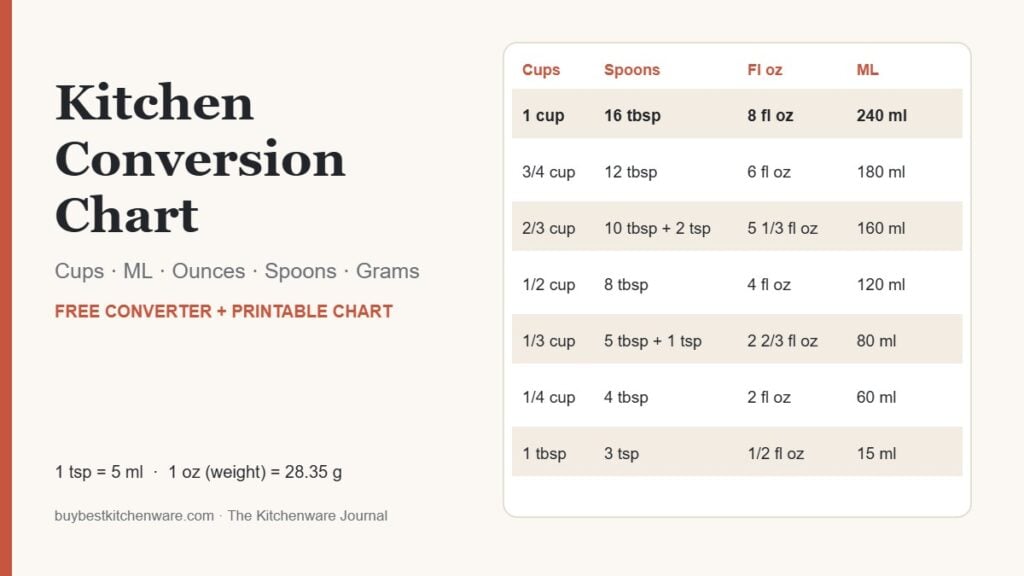
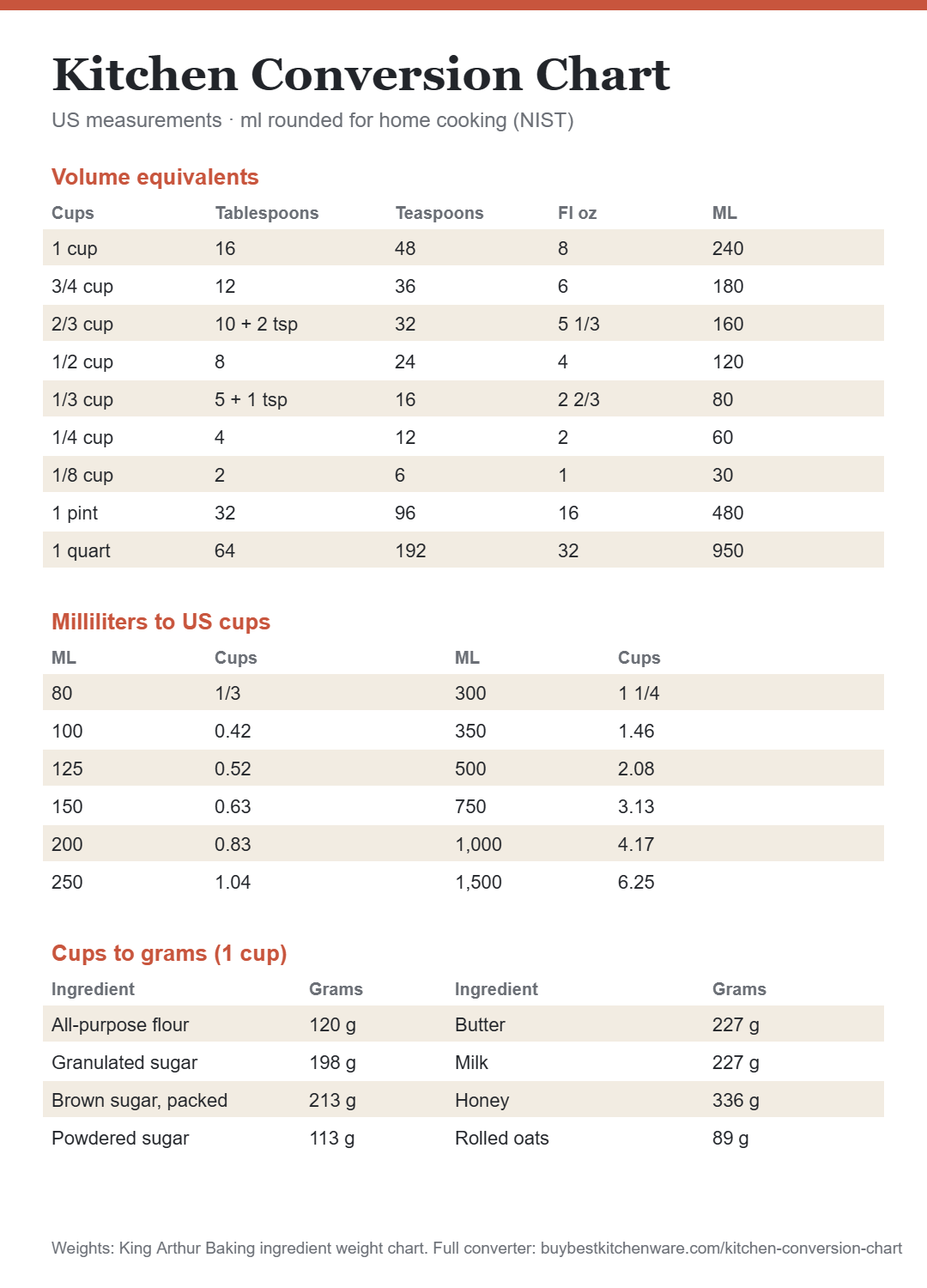
This is the chart to pin to the fridge. Milliliters use the rounded home-cooking values from NIST’s kitchen equivalency table; the exact value is in brackets where the difference matters.
| Cups | Tablespoons | Teaspoons | Fluid ounces | Milliliters |
|---|---|---|---|---|
| 1/16 cup | 1 tbsp | 3 tsp | 1/2 fl oz | 15 ml (14.8) |
| 1/8 cup | 2 tbsp | 6 tsp | 1 fl oz | 30 ml (29.6) |
| 1/4 cup | 4 tbsp | 12 tsp | 2 fl oz | 60 ml (59) |
| 1/3 cup | 5 tbsp + 1 tsp | 16 tsp | 2 2/3 fl oz | 80 ml (79) |
| 1/2 cup | 8 tbsp | 24 tsp | 4 fl oz | 120 ml (118) |
| 2/3 cup | 10 tbsp + 2 tsp | 32 tsp | 5 1/3 fl oz | 160 ml (158) |
| 3/4 cup | 12 tbsp | 36 tsp | 6 fl oz | 180 ml (177) |
| 1 cup | 16 tbsp | 48 tsp | 8 fl oz | 240 ml (236.6) |
| 2 cups (1 pint) | 32 tbsp | 96 tsp | 16 fl oz | 480 ml (473) |
| 4 cups (1 quart) | 64 tbsp | 192 tsp | 32 fl oz | 950 ml (946) |
| 16 cups (1 gallon) | 256 tbsp | 768 tsp | 128 fl oz | 3.8 L (3,785 ml) |
For a printable version focused on ounces, see our ounce conversion chart, and for everyday foods by weight and volume, the food measurements chart.
Milliliters to cups
Divide milliliters by 240 to get US cups (or by 236.6 for the exact figure). A US cup holds about 240 ml, while the metric cup used in Australia, Canada and the UK is 250 ml. That 10 ml gap rarely matters in soups and sauces, but it adds up in baking.
| Milliliters | US cups (240 ml cup) | Closest kitchen measure | Full guide |
|---|---|---|---|
| 80 ml | 0.33 | 1/3 cup | 80 ml to cups |
| 100 ml | 0.42 | 1/3 cup + 1 1/3 tbsp | 100 ml to cups |
| 125 ml | 0.52 | 1/2 cup + 1 tsp | 125 ml to cups |
| 150 ml | 0.63 | 1/2 cup + 2 tbsp | 150 ml to cups |
| 200 ml | 0.83 | 3/4 cup + 1 1/3 tbsp | 200 ml to cups |
| 250 ml | 1.04 | 1 cup + 2 tsp | 250 ml to cups |
| 300 ml | 1.25 | 1 1/4 cups | 300 ml to cups |
| 330 ml | 1.38 | 1 1/3 cups + 2 tsp | 330 ml to cups |
| 350 ml | 1.46 | 1 1/3 cups + 2 tbsp | 350 ml to cups |
| 500 ml | 2.08 | 2 cups + 1 1/3 tbsp | 500 ml to cups |
| 750 ml | 3.13 | 3 cups + 2 tbsp | 750 ml to cups |
| 1,500 ml | 6.25 | 6 1/4 cups | 1,500 ml to cups |
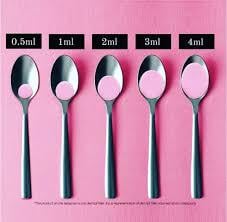
Small amounts are easier in spoons: 1 ml is a fifth of a teaspoon, 4 ml is just under a teaspoon, and 5 ml is exactly one teaspoon. A cc (cubic centimeter) is the same as a milliliter, so a teaspoon is 5 cc and a tablespoon is 15 cc.
Ounces to cups (and why there are two kinds of ounce)
A fluid ounce measures volume: 8 fl oz fill one cup. A weight ounce measures mass: 1 oz = 28.35 g. They only line up for water and water-like liquids. A cup of flour weighs about 4.2 oz, not 8, while a cup of honey weighs nearly 12 oz. If a recipe lists ounces for a dry ingredient, it almost always means weight, so use a scale. Our guide on how to measure ounces walks through both.
| Fluid ounces | US cups | Full guide |
|---|---|---|
| 2 fl oz | 1/4 cup | How much is 2 ounces |
| 3 fl oz | 3/8 cup (6 tbsp) | How much is 3 ounces |
| 4 fl oz | 1/2 cup | How much is 4 ounces |
| 10 fl oz | 1 1/4 cups | 10 ounces to cups |
| 15 fl oz | 1 7/8 cups | 15 oz to cups |
| 20 fl oz | 2 1/2 cups | 20 oz to cups |
| 24 fl oz | 3 cups | 24 oz to cups |
| 32 fl oz | 4 cups (1 quart) | 32 oz to cups |
| 40 fl oz | 5 cups | 40 oz to cups |
| 64 fl oz | 8 cups (half gallon) | 64 fl oz to cups |
| 80 fl oz | 10 cups | 80 oz to cups |
| 96 fl oz | 12 cups (3 quarts) | 96 ounces to cups |
Ingredients sold by weight need their own conversion: see ounces in a cup of chocolate chips, ounces in 2 cups of shredded cheese, 8 oz of butter in cups, a cup of sour cream in ounces and a cup of flour in ounces.
Tablespoons and teaspoons
There are 3 teaspoons in a tablespoon and 16 tablespoons in a cup. A teaspoon is not half a tablespoon, a common slip covered in is a teaspoon half a tablespoon?, and recipes abbreviate them as tsp (small t) and tbsp (capital T); see tsp vs tbsp.
- 1 teaspoon = 5 ml = 1/6 fl oz (ounces in a teaspoon, tsp to ml)
- 1 tablespoon = 15 ml = 1/2 fl oz (ml in a tablespoon)
- 1/8 cup = 2 tablespoons (tablespoons in 1/8 cup)
- 1 pint = 32 tablespoons (tablespoons in a pint)
- 1/4 teaspoon = 1.25 ml and 1/8 teaspoon = about 0.6 ml (1/4 teaspoon, 1/8 teaspoon)
- 1 sugar cube = about 1 teaspoon of granulated sugar (sugar cube to tsp)
New to spoon sizes? Start with what is a teaspoon and our guide to measuring spoon sizes.
Fractions of a cup
Most measuring-cup sets include 1/4, 1/3, 1/2 and 1 cup (see the 4 sizes of dry measuring cups). Everything else is built from those:
- 2/3 cup = two 1/3 cups, or 10 tbsp + 2 tsp (how much is 2/3 cup)
- 1/3 cup = 5 tbsp + 1 tsp (what is 1/3 + 1/3 cup)
- 3/4 cup = three 1/4 cups, or two 1/3 cups plus 1 tablespoon and 1 teaspoon (how many 1/3 cups make 3/4 cup)
- 1/2 cup = two 1/4 cups (how many 1/4 cups make 1/2 cup)
- Reading a liquid measuring cup: where is 1/4 cup on a measuring cup
Cups to grams by ingredient
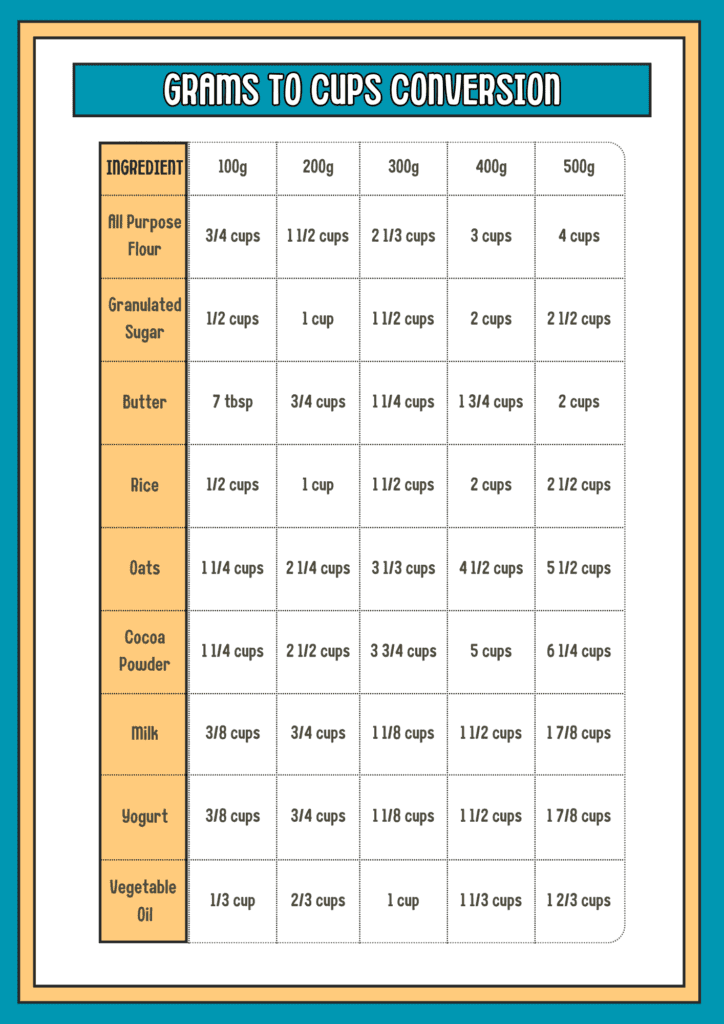
A cup is a volume, so its weight depends on what is in it. Bakers who weigh ingredients get the same result every time; bakers who scoop can be off by 20% or more on flour. These figures come from the King Arthur Baking ingredient weight chart, which assumes flour is spooned into the cup and leveled.
| Ingredient (1 cup) | Grams | Ounces (weight) |
|---|---|---|
| All-purpose or bread flour | 120 g | 4.2 oz |
| Granulated sugar | 198 g | 7 oz |
| Brown sugar, packed | 213 g | 7.5 oz |
| Powdered sugar, unsifted | 113 g | 4 oz |
| Butter (2 sticks) | 227 g | 8 oz |
| Milk, cream or sour cream | 227 g | 8 oz |
| Vegetable oil | 198 g | 7 oz |
| Honey (21 g per tbsp) | 336 g | 11.9 oz |
| Rolled oats | 89 g | 3.1 oz |
| Cocoa powder | 84 g | 3 oz |
| Chocolate chips | 170 g | 6 oz |
| Long-grain rice, dry | 198 g | 7 oz |
| Water | 237 g | 8.3 oz |
More weight conversions: weight of 1 cup of water, 1 cup of whole milk in grams, cups of sugar in a pound, 340 g to cups and ml in 1 gram.
Pints, quarts and gallons
2 cups make a pint, 2 pints make a quart, and 4 quarts make a gallon. In milliliters, a pint is about 473 ml, a quart is about 946 ml and a gallon is about 3.79 liters. Half a pint is 8 fl oz (ounces in half a pint). UK (imperial) pints are larger at 568 ml, so British recipes need adjusting.
Everyday measures: a glass of water
When people talk about “a glass of water”, they usually mean 8 fl oz, which is 1 cup or about 240 ml. Real glasses range from 6 to 16 oz, so check yours once with a measuring cup. Details: 1 glass of water in ounces, 1 glass of water in ml and 8 cups of water in ounces.
Tools That Make Conversions Unnecessary
The easiest conversion is the one you don’t have to do. A scale that switches between grams and ounces, plus a good set of cups and spoons, covers almost every recipe you’ll meet.
1. Etekcity 22 lb Rechargeable Kitchen Scale (Best Scale)

A USB-rechargeable digital scale that reads grams and ounces, with a water-resistant body.
Why We Like It
It handles big batches up to 22 lb, and switching units turns any gram-based recipe into a one-bowl job.
Flaws to Know
- Larger footprint than slim scales
Buy it if: you bake from metric recipes. Skip it if: counter space is very tight.
Key Specs
- Capacity: 22 lb
- Charging: USB
- Water resistance: IPX6 per listing
2. Spring Chef Stainless Measuring Cups and Spoons, 14-Piece (Best Cups and Spoons Set)

Nesting stainless cups and spoons with engraved markings and a leveler.
Why We Like It
Engraved sizes stay readable for years, and the set covers the in-between sizes like 2/3 cup.
Flaws to Know
- Ring is fiddly
Buy it if: you want one set that lasts. Skip it if: you already weigh everything.
Key Specs
- Pieces: 14
- Material: stainless steel
3. U-Taste 18/8 Stainless Measuring Spoons, Set of 9 (Best Spoon Set)
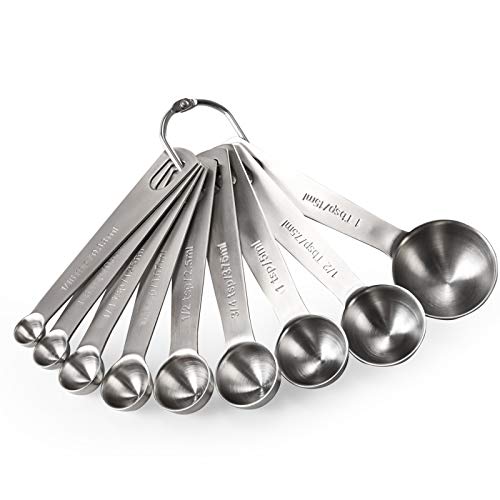
Nine stainless spoons, including the small sizes many sets skip.
Why We Like It
Odd sizes like 1/8 teaspoon and 1/2 tablespoon save you from doing fraction maths mid-recipe.
Flaws to Know
- Spoons only, no cups
Buy it if: you want every spoon size. Skip it if: you rarely bake.
Key Specs
- Pieces: 9
- Material: 18/8 stainless
4. Anchor Hocking Glass Measuring Cups, 3-Piece (1, 2 and 4 Cup) (Best Liquid Measuring Cups)
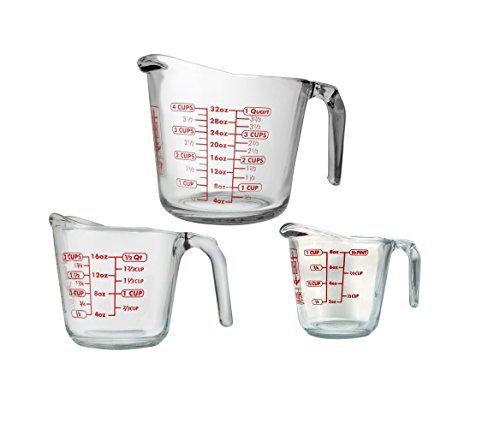
Three classic glass measuring cups with printed cup and ml markings.
Why We Like It
Having cups and milliliters on the same glass means no conversion at all for liquids.
Flaws to Know
- Glass can break if dropped
Buy it if: you measure liquids often. Skip it if: you need shatterproof gear.
Key Specs
- Sizes: 1, 2 and 4 cup
- Material: glass
5. OXO Good Grips 2-Cup Angled Measuring Cup (Easiest to Read)

A liquid measuring cup with markings on an angled ramp inside.
Why We Like It
You read the level from above instead of crouching to eye level, and it shows cups, ounces and ml.
Flaws to Know
- Plastic, so not for very hot liquids over long periods
Buy it if: you hate squinting at measuring lines. Skip it if: you want glass only.
Key Specs
- Capacity: 2 cups
- Markings: cups, oz, ml
6. KitchenArt Adjust-A-Cup, 2 Cup (Best for Sticky Ingredients)
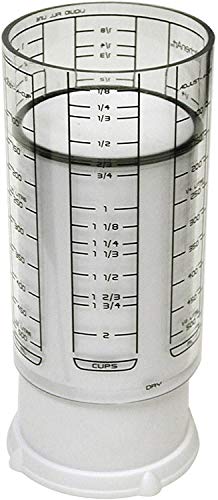
A plunger-style cup you set to any amount from 1/8 to 2 cups.
Why We Like It
Push the plunger and peanut butter, honey or shortening slide straight out. It also has conversions printed on it.
Flaws to Know
- Plastic
- Takes a moment to set
Buy it if: you measure sticky ingredients. Skip it if: you mostly measure liquids.
Key Specs
- Range: 1/8 to 2 cups
7. Kitchen Conversion Chart Magnet, 6 x 8 Inch (Best Fridge Reference)
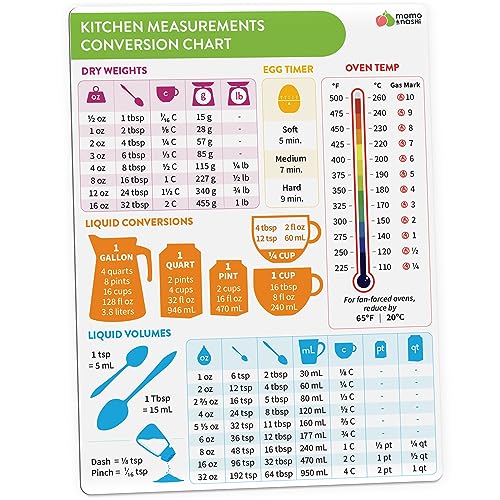
A waterproof magnet with liquid and dry conversions.
Why We Like It
The numbers you check most, stuck right where you cook, no phone needed with floury hands.
Flaws to Know
- Fixed chart, no weight-by-ingredient detail
Buy it if: you want a quick glance reference. Skip it if: you already know the basics.
Key Specs
- Size: 6 x 8 in
Conversion Tips for the UK, Canada and the EU
UK: most modern UK recipes use grams and ml, so a scale is all you need. Older recipes may use imperial pints (568 ml) and fluid ounces (28.4 ml), which are bigger and smaller than US ones respectively. Oven temperatures are in °C or gas marks.
Canada: recipes often list both US cups and grams. Canadian measuring cups are usually marked 250 ml, close enough to a US cup for everyday cooking.
EU: everything is metric, including butter by weight instead of sticks. One US stick of butter is 113 g. For oven settings, 350°F is about 175 to 180°C, or about 160°C with a fan.
Frequently Asked Questions
How many tablespoons are in a cup?
16 tablespoons, or 48 teaspoons, in a US cup.
How many ml are in a US cup?
About 237 ml. Many charts round it to 240 ml, and metric cups in Canada and Australia are 250 ml.
Is a UK pint the same as a US pint?
No. A UK pint is about 568 ml, while a US pint is about 473 ml.
Should I convert flour by volume or weight?
By weight. A cup of all-purpose flour is about 120 to 125 g depending on how you fill it, so grams are more reliable.
How many grams is a stick of butter?
About 113 g, which is 8 tablespoons or 1/2 cup.

Reviewed by Nathan Miller, Chief Editor & Kitchen Equipment Expert. Nathan has cooked for more than ten years, has reviewed kitchenware for The Kitchenware Journal since 2022, and covers cast iron and stainless cookware, Dutch ovens, woks, multi-cookers, fermentation gear and measuring tools. Our lab logs fermentation temperatures with a calibrated thermocouple data logger. He previously cooked professionally in restaurants in South Korea, Saudi Arabia and the US. How we test.
Related guides: How Many Teaspoons in a Tablespoon · How Many Milliliters in a Cup · Ounce Conversion Chart · Baking Equipment List