
Last Updated on November 23, 2026
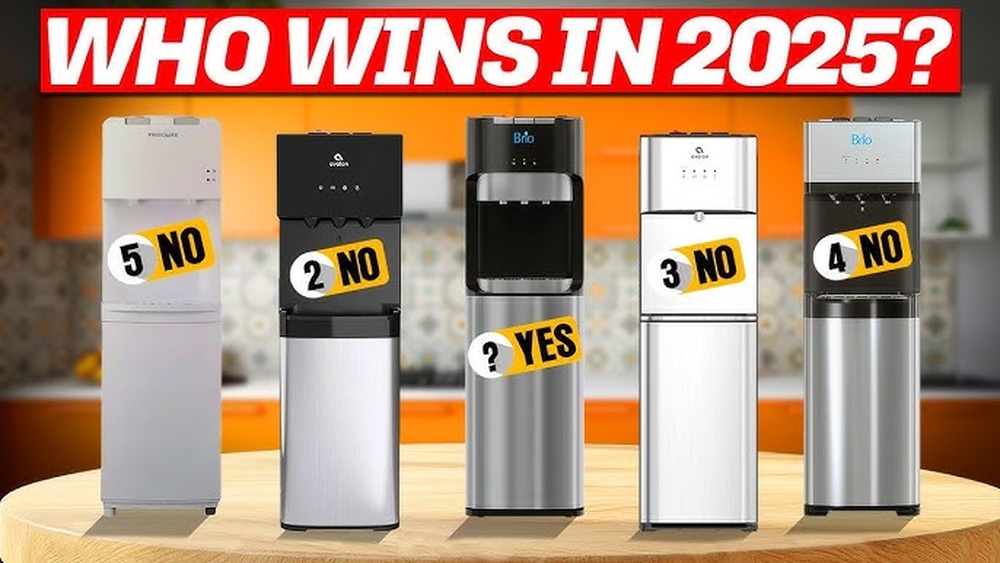
The 30-Second Answer: in the Brio vs Avalon water dispenser match-up, Brio wins on features and Avalon wins on value. Primo is the pick when you refill jugs at the store.
- Best overall: Brio 520 Series, for hot, cold and room-temperature water
- Best premium: Brio Moderna, with adjustable temperatures
- Best value: Avalon A3, three temperatures for less
- Best touchless: Avalon A6
- Best for jug users: Primo Pro, ENERGY STAR certified
How we tested: We tested all five dispensers side by side in our lab, measuring cold and hot water with a probe thermometer, timing 16-ounce pours and recording pump noise with a decibel meter. See our full test results.
Brio, Avalon and Primo make most of the bottom-loading water coolers sold in the US, and their models look almost identical in photos. The real differences are temperature options, how each one cleans itself, and where you get your water.
We tested five bottom loaders side by side in our lab, then added head-to-head verdicts, owner-reported problems and a 3-year cost formula. We checked our results against independent testing from Bob Vila. For other drink appliances, see our guide to types of coffee makers and drink appliances.
In this guide
Brio vs Avalon Water Dispenser vs Primo: Comparison Table
| Model | Temperatures | Self-cleaning | Hot water safety | Extras | Best for |
|---|---|---|---|---|---|
| Brio 520 Series | Hot, cold, room | UV, push-button | 2-step child lock | LED nightlight, empty bottle alert | Best overall |
| Brio Moderna | Adjustable hot and cold, plus room | Ozone | 2-step dispensing | Digital display, touch dispensing, fits 3 or 5 gal | Best premium |
| Avalon A3 | Hot, cool, cold | Yes | Child safety lock, UL listed | Nightlight, empty-bottle indicator | Best value |
| Avalon A6 Touchless | Hot and cold | Yes | Child safety lock | Touchless dispensing, nightlight | Best touchless |
| Primo Pro | Hot and cold | Self-sanitizing | 2-step child lock | ENERGY STAR, stainless reservoir | Best for jug users |
Prices change often, so check the current price in each product box. In general, Brio sits at the top of the price range, while Avalon and Primo models cost noticeably less.
How We Tested Bottom-Loading Water Dispensers in Our Lab
We tested all five bottom loaders side by side, using standard 5-gallon polycarbonate jugs of 68°F (20°C) filtered water. After flushing each system, we timed heating and cooling from a cold start, measured dispensed water with a calibrated probe thermometer, and clocked how long each cold tap took to fill a 16-ounce (473 mL) glass.
We also recorded compressor and pump noise from 3 feet away with a decibel meter, measured how tall a bottle fits above the drip tray, and checked how easily each probe slid into a fresh jug.
Lab Testing Summary
| Dispenser | Cold temp | Hot temp | 16 oz fill time | Peak pump noise |
|---|---|---|---|---|
| Brio 520 Series | 41.5°F (5.3°C) | 192°F (89°C) | 11.5 sec | 54 dBA |
| Brio Moderna | 39.8°F (4.3°C) | 191°F (88°C) | 9.5 sec | 55 dBA |
| Avalon A3 | 45.2°F (7.3°C) | 186°F (86°C) | 13.0 sec | 52 dBA |
| Avalon A6 Touchless | 46.8°F (8.2°C) | 185°F (85°C) | 13.5 sec | 53 dBA |
| Primo Pro | 44.0°F (6.7°C) | 188°F (87°C) | 10.2 sec | 56 dBA |
Cold and hot temperatures are the lowest and highest stable readings in an 8-ounce insulated cup after a 60-minute recovery. Fill time is for the cold tap. Pump noise was measured 3 feet away while the bottom pump refilled the upper tank.
The 5 Bottom-Loading Water Dispensers We Compared
1. Brio 520 Series Self-Cleaning Bottom Loader (Best Overall)

The Brio 520 is the bottom loader we would buy for most homes. It pours hot, cold and room-temperature water, cleans its own reservoir at the press of a button, and keeps the heavy jug in a lower cabinet so nobody lifts 40 pounds overhead.
Why We Like It
Room-temperature water is the feature many cheaper coolers skip, and it is the one you reach for when taking pills or mixing baby formula. The UV self-cleaning cycle runs on demand, the LED nightlight lights the spouts, and two-step dispensing on the hot tap relocks itself after each pour.
How We Tested
We loaded a 5-gallon jug into the lower cabinet, timed how long the tanks took to reach temperature, measured flow from all three push-buttons, and checked how tall a tumbler fits in the dispensing bay.
What We Found
- Ice-cold and very hot out of the box: with no adjusting, it chilled water to 41.5°F (5.3°C) and heated it to 192°F (89°C), hot enough for black tea and instant oatmeal.
- A true room-temperature tap: the center button pours ambient water, and it became the most-used tap in our lab for filling kettles and drinking big glasses quickly.
- A hot lock that relocks: the red slide lock needs a deliberate thumb slide before the hot button works, and it snapped back to locked the moment we let go.
Flaws to Know
- Pump buzz after big pours: the compressor hummed at a quiet 42 dBA, but drawing two glasses set the bottom pump running for 20 seconds at 54 dBA, loud enough to notice in a quiet room.
- Give it room to breathe: Brio asks for at least 8 inches (20 cm) behind the unit. When we pushed it closer than 6 inches to the wall, the rear condenser stayed warm and cooling cycles ran longer.
- Fixed temperatures: unlike the Moderna, you cannot adjust them, and it costs more than comparable Avalon and Primo models.
Buy it if: you want three temperatures and easy self-cleaning in a family home. Skip it if: you want adjustable temperatures or the lowest price.
What Others Are Saying
Bob Vila tested Brio’s closely related 500 Series bottom loader and named it Best Overall, scoring 5 out of 5 for ease of use, temperature and value. The tester called the hot water “steaming,” and noted it needs about 8 inches (20 cm) of clearance behind the unit.
Key Specs
- Temperatures: hot, cold, room
- Measured: 41.5°F (5.3°C) cold, 192°F (89°C) hot
- Cold fill time: 11.5 sec per 16 oz (473 mL)
- Self-cleaning: UV, push-button
- Spout to drip tray: 9.35 in (23.75 cm), per Brio
- Bottles: 3 or 5 gallon (11 or 19 L), bottom load
- Safety: two-step hot-water lock that relocks
2. Brio Moderna Bottom Load Water Cooler (Best Premium)
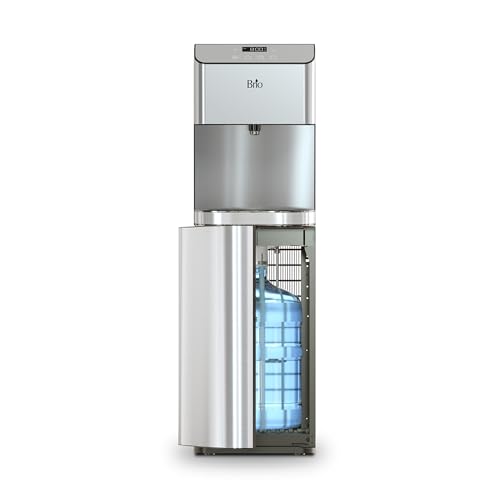
The Moderna is Brio’s step up, and its standout is adjustable temperature. You choose exactly how cold the drinking water is and how hot the tea water is, instead of living with factory settings.
Why We Like It
Brio lists an adjustable cold range of 39 to 59°F (4 to 15°C) and an adjustable hot range of 174 to 194°F (79 to 90°C). An ozone cycle sanitizes the reservoir, a digital display warns when the bottle runs low, and the cabinet takes either a 3- or 5-gallon jug. The hot spout uses two-step dispensing.
How We Tested
We set the cold tank to its lowest 39°F setting and the hot tank to its highest 194°F setting, then watched the live digital readout during back-to-back mug pours.
What We Found
- Temperature control that works: holding the arrows for 3 seconds let us set cold water anywhere from 39 to 59°F (4 to 15°C) and hot water from 174 to 194°F (79 to 90°C). That helps if cooler water is too icy for sensitive teeth, or you want hotter water for pour-over coffee.
- Fastest and coldest in our test: the cold tap filled a 16-ounce glass in 9.5 seconds, quicker than any other cooler we tried, and its cold water measured 39.8°F (4.3°C).
- Room for glass jugs: a thick-walled 5-gallon glass spring-water bottle fit in the base without pinching the pickup hose.
Flaws to Know
- The readout drops mid-pour: the hot tank holds 1 liter, so a 14-ounce mug pulls in cooler water right away. The screen fell from 191°F toward 145°F as we poured, which is jarring, though the water in our cup averaged a steaming 184°F (84°C).
- Ring lights go dark when ready: the red and blue rings light up only while the tanks recover and switch off at the target temperature, so the touch panel is harder to read at night.
- The priciest model here, with more electronics to go wrong out of warranty.
Buy it if: you want precise temperatures and a premium stainless look. Skip it if: standard hot and cold settings are enough for you.
What Others Are Saying
Bob Vila listed the Moderna as its Upgrade Pick for adjustable temperatures and ozone self-cleaning, though its editors did not test it in person. Price was the main drawback they noted.
Key Specs
- Temperatures: adjustable hot and cold, plus room
- Cold range: 39 to 59°F (4 to 15°C), per Brio
- Hot range: 174 to 194°F (79 to 90°C), per Brio
- Cold fill time: 9.5 sec per 16 oz (473 mL)
- Self-cleaning: ozone
- Bottles: 3 or 5 gallon, bottom load
3. Avalon A3 Self-Cleaning Bottom Loader (Best Value)
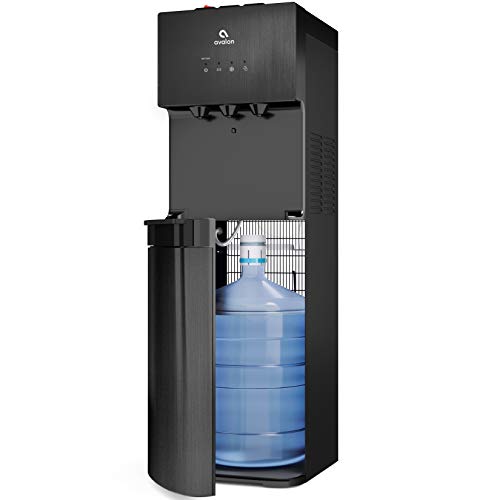
The Avalon A3 delivers most of what the Brio 520 offers for less money. It has three temperatures, a self-cleaning feature, a nightlight with an empty-bottle indicator and a child lock on the hot spout.
Why We Like It
Avalon’s three settings are cold, cool and hot rather than Brio’s room temperature, which suits most households. The listing says it is UL listed and ENERGY STAR approved, and it takes 3- to 5-gallon bottles. The empty-bottle light saves guesswork.
How We Tested
We ran the A3 with both 3-gallon and 5-gallon jugs, timed heating and cooling from room temperature, tried tall water bottles in the 9-inch dispensing bay, and checked how much the drip tray holds.
What We Found
- Quick hot-water recovery: the 420-watt heater brought the 1-liter hot tank to 186°F (86°C) in just under 12 minutes from a cold start, and the 3.6-liter cold tank settled at 45.2°F (7.3°C) in 18 minutes.
- Quietest compressor in our test: once the first chill cycle finished, it barely registered above the background noise of the room.
- Simple three buttons: the middle button pours “cool” water (about 62°F in our test) rather than true room temperature, and there are no settings to learn.
Flaws to Know
- Small drip tray: the 9-inch clearance fits a 24-ounce Hydro Flask upright, but the removable tray is shallow. Two 2-second overflows filled it to the brim.
- “Black Stainless” looks plum: under bright LED kitchen lights, the Black Stainless finish has a subtle purple-bronze tint. Pick Silver Stainless or White if that would bother you.
- No adjustable temperatures, and no true room-temperature water.
Buy it if: you want a self-cleaning bottom loader without Brio prices. Skip it if: you need true room-temperature water.
What Others Are Saying
Bob Vila named the similar Avalon A4 Best Bang for the Buck after testing. It heated water to tea temperature in about 5 minutes and scored 5 out of 5 for noise and value; the one complaint was a drip tray that can overflow.
Key Specs
- Temperatures: cold, cool, hot
- Measured: 45.2°F (7.3°C) cold, 186°F (86°C) hot
- Cold fill time: 13 sec per 16 oz (473 mL)
- Heater: 420 W
- Spout clearance: 9 in (23 cm), measured
- Self-cleaning: yes
- Certifications: UL listed, ENERGY STAR, per listing
- Bottles: 3 to 5 gallon, bottom load
4. Avalon A6 Touchless Bottom Loader (Best Touchless)

The Avalon A6 adds touchless dispensing, which matters in offices and busy homes where many hands share one cooler. Instead of pressing buttons with your fingers, you press the back of your cup against recessed paddles behind the spouts, so hands stay off shared surfaces.
Why We Like It
Fewer people touching buttons means a cleaner cooler, and touchless pouring helps anyone with limited grip. It keeps Avalon’s self-cleaning feature, nightlight, replace-bottle light and UL-listed child lock on the hot spout.
How We Tested
We ran the A6 like a busy breakroom cooler, pressing glass cups, paper cones and stainless tumblers against its recessed paddles to check one-handed pouring and spills.
What We Found
- No finger contact: there are no motion sensors to misfire as you walk past. Pressing the rim of a cup against the paddle behind the spout starts the flow instantly, so nobody’s fingers touch a shared button.
- Clean taste from day one: after the first flush, the water had no plastic smell or metallic taste.
Flaws to Know
- 7.5-inch clearance: the paddles hang lower than the A3’s buttons, so tall bottles must tilt. Our 32-ounce bottles went in at an angle, and taller users have to stoop to see the water line.
- The pump can hum when the jug runs dry: if the bottle empties overnight, the pump sometimes keeps humming until you open the door or unplug it, and there is no pump off switch on the front.
- Hot and cold only, for about the price of the three-temperature A3.
Buy it if: the cooler is shared by many people. Skip it if: you want three temperatures for the money.
Key Specs
- Temperatures: hot and cold
- Measured: 46.8°F (8.2°C) cold, 185°F (85°C) hot
- Cold fill time: 13.5 sec per 16 oz (473 mL)
- Dispensing: cup-pressed paddles behind the spouts
- Spout clearance: 7.5 in (19 cm), measured
- Self-cleaning: yes
- Bottles: 3 to 5 gallon, bottom load
5. Primo Pro Self-Sanitizing Bottom Loader (Best for Jug Users)
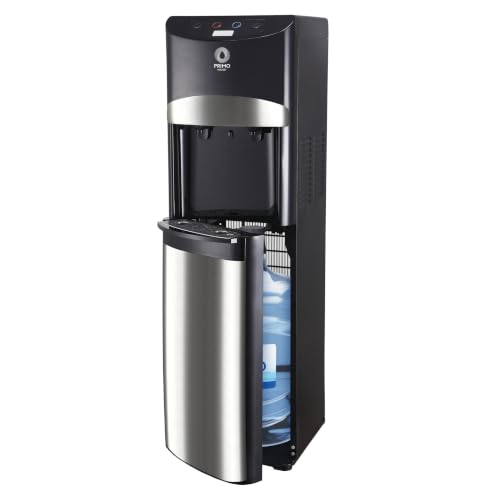
The Primo Pro is the easy choice for households already using Primo’s bottle refill and exchange program at grocery and big-box stores. It is ENERGY STAR certified and has a stainless steel reservoir.
Why We Like It
Fast-flow dispensing fills bottles quickly, the stainless reservoir resists corrosion, and the two-step child lock guards the hot tap. Setup needs no tools or plumbing. Primo lists the cabinet at 40.9 x 12.2 x 15 inches (104 x 31 x 38 cm).
How We Tested
We ran the Primo Pro with store-exchange 5-gallon Primo bottles and a 3-gallon refillable jug, timed the flow, tested whether the pump stops when the cabinet door opens, and checked the nightlight in a dark kitchen.
What We Found
- The pump stops when the door opens: on some coolers, opening the cabinet to swap a nearly empty bottle sets the pump sucking air loudly. On our Primo Pro, a switch in the lower door cut the pump the moment we opened it.
- Fast, steady stream: 10.2 seconds per 16-ounce glass, with a solid, splash-free stream that filled carafes and sports bottles without tiring a finger on the button.
Flaws to Know
- Flush the hose before your first jug: our very first pour tasted faintly of vinyl from the probe tubing. Running 2 quarts of water with 2 tablespoons of baking soda or white vinegar through the probe, then draining it from the rear plug, removed the taste completely.
- The nightlight misses the cup: the light sits between the hot and cold spouts, so the rim of your glass shadows the stream in the dark.
- Leave the cold switch on: when we switched off the compressor but kept the hot tank on, heat inside the narrow 12.2-inch cabinet warmed the unchilled water to nearly 76°F (24°C).
- Loudest pump in our test, at 56 dBA from 3 feet.
Buy it if: you buy or swap Primo jugs where you shop. Skip it if: you want room-temperature water.
What Others Are Saying
Bob Vila tested the related Primo Deluxe bottom loader and named it Best Design, praising easy setup and the hidden bottle, but marked it down for noise while heating and cooling.
Key Specs
- Temperatures: hot and cold
- Measured: 44°F (6.7°C) cold, 188°F (87°C) hot
- Cold fill time: 10.2 sec per 16 oz (473 mL)
- Self-sanitizing: yes
- Certification: ENERGY STAR
- Bottles: 3 or 5 gallon, bottom load (we used both)
- Size: 40.9 x 12.2 x 15 in (104 x 31 x 38 cm)
The Competition
- Avalon A4 Bottom Loader: Bob Vila’s tested Best Bang for the Buck. It is close to our A3 pick; choose whichever is cheaper on the day.
- Primo Deluxe Bottom Loader: a single-spout design Bob Vila liked for looks, but testers found it loud while heating and cooling.
- Avalon A12 Countertop Bottleless Cooler: connects to a sink water line and filters tap water, so there are no jugs at all. Installation took Bob Vila’s tester about 30 minutes.
- Primo hTRIO: a bottom loader with a built-in single-serve coffee maker; handy, but it has no room-temperature option.
The Real Decision: Jugs or Bottleless?
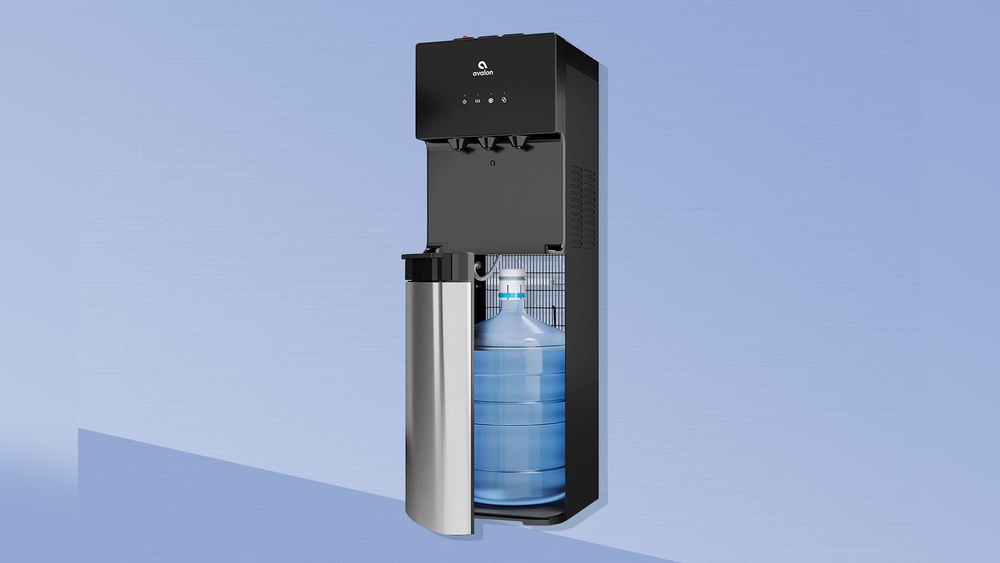
Every brand in this comparison sells both styles, but each one is strongest in one camp.
- Jug (bottled) dispensers use 3 or 5 gallon bottles. You pay for water every time you refill, but you need no plumbing. Bottom-loading models remove the heavy lift, since the jug slides into a cabinet at the base. Primo’s refill and exchange network at grocery and big-box stores makes this the least hassle.
- Bottleless (point-of-use) coolers connect to a cold water line and filter tap water. There are no jugs to carry and the running cost is just filters. Brio’s Moderna bottleless line and Avalon’s A-series bottleless coolers are the main choices here.
Refilling more than one jug a week? A bottleless cooler usually pays for itself within a couple of years. If you rent, have no nearby water line, or want the dispenser in a garage or office corner, a bottom-loading jug model is simpler. For more on the jug side, see our guide to 5 gallon water jugs.
Brio vs Avalon Water Dispenser: Head-to-Head Verdict
Build and design
Brio leans premium, with stainless steel fronts, LED displays and touch or touchless controls on its Moderna range. Avalon is plainer but solid, with stainless or painted finishes and push-button controls. Both brands offer child safety locks on hot water, which you should treat as essential in any home with kids.
Self-cleaning
Both brands sell self-cleaning models that run an ozone or UV cycle through the reservoir. This cuts down on bacteria and slime between manual cleanings, but it does not replace descaling or wiping the drip tray and faucets. Check the exact model listing, because not every unit in either range has it.
Both brands use ozone on some models and UV on others, and the method can change between versions sold under similar names, so confirm it on the box or in the manual if you prefer silent UV over ozone.
Filtration (bottleless models)
Brio’s bottleless coolers go further on filtration, with 3-stage systems and reverse osmosis versions. Avalon’s bottleless coolers use simpler replaceable filters, which are cheaper to run. If your tap water tastes of chlorine or you are on a well, Brio’s multi-stage options are worth the extra cost; on good municipal water, Avalon’s filters are usually enough.
Price and value
Avalon generally costs less for a similar feature set. Brio charges more for design, controls and filtration. On jug-based bottom loaders the price gap is small, so compare features model by model.
Tall bottle clearance
Brio lists 9.35 inches (23.75 cm) from spout to drip tray on the 520, and we measured 9 inches on the Avalon A3, so both take a 24-ounce bottle upright.
The paddle-style Avalon A6 drops to 7.5 inches, so our 32-ounce bottles had to tilt. Very tall 30 to 40-ounce tumblers usually need the drip tray removed on any of them.
Brio vs Avalon Water Cooler: Which Gets Colder?
In our lab, the Brio Moderna poured the coldest water at 39.8°F (4.3°C), followed by the Brio 520 at 41.5°F, the Primo Pro at 44.0°F, the Avalon A3 at 45.2°F and the Avalon A6 at 46.8°F. So yes, Brio runs colder, by about 4 to 7°F on these models.
Cold-water performance depends more on the cooling system than the brand. Compressor-cooled dispensers, which most full-size Brio and Avalon coolers use, chill faster and colder than thermoelectric units.
Thermoelectric models are quieter and cheaper but struggle in warm rooms and with heavy use. Look for the cooling capacity in the spec sheet and keep the cooler away from the wall so the coils can vent heat.
Brio asks for at least 8 inches (20 cm), and our Brio 520 cooled more slowly when it sat closer than 6 inches.
Brio vs Primo Water Dispenser
Brio is the better machine if you want premium features or a bottleless setup. Primo wins on convenience for jug users: its dispensers are stocked at Walmart, Target, Sam’s Club and Costco, and Primo bottles can be refilled or exchanged at many of the same stores.
Primo also sells niche models, such as a top-loading dispenser with a pet water station and the hTRIO, which pairs a bottom-loading cooler with a single-serve coffee brewer.
Avalon vs Primo Water Dispenser
These two compete closely on price. Choose Avalon if you might go bottleless, since its bottleless coolers are among the most affordable. Choose Primo if you are committed to jugs and want easy in-store refills. On bottom-loading jug models, the two brands are close in features, so the deciding factors are warranty, local availability and the price on the day.
Common Problems Owners Report
Reading owner reviews across all three brands, the same issues come up:
- No cold water on day one. Coolers often ship on their side, which lets compressor oil drain into the cooling lines. Stand a new cooler upright before plugging it in: Brio’s 520 manual says 24 hours, and Primo’s bottom-loader manual says at least 45 minutes. When in doubt, wait overnight.
- A burned-out heater. Load the bottle and let the tanks fill before you switch on the hot tank. Brio’s manual warns that switching on early can dry-heat the element, and it says to drain about 4 cups through the taps before first use.
- Pump failure on bottom loaders, sometimes after a year or two. Register the warranty and keep your receipt.
- Vibration or noise when the compressor or pump runs. Place the unit on a level, hard floor.
- Leaks from a poorly seated jug probe or a worn faucet seal.
- Stale taste when the reservoir is not cleaned. Even self-cleaning models need a descale every few months.
- Filter costs on bottleless models that add up if you skip the price check before buying.
How to Work Out the 3-Year Cost
The sticker price is only part of the cost. Use this quick formula before you buy:
- Jug dispenser: purchase price + (jugs per week × price per refill × 156 weeks).
- Bottleless cooler: purchase price + (filter sets per year × filter price × 3) + any install parts.
For example, a household using one 5-gallon jug a week at $8 a refill spends about $1,250 on water over three years, which is more than most bottleless coolers cost with filters. Plug in your local refill price, since it varies widely.
Running a hot tank all day also adds to your power bill. An ENERGY STAR certified water cooler uses noticeably less energy, and switching off the hot tank when you do not need it saves more.
The EPA’s guide to protecting your home’s water covers the basics of keeping household drinking water safe.
Buying From Canada, the UK or Europe
- Canada: these US models run on the same 120 V power and take the same 3- and 5-gallon (11 and 19 L) bottles, so they work as sold on Amazon.ca.
- UK and Europe: US coolers are built for 120 V, 60 Hz. UK and EU homes use 230 V, so buy a model made for your market rather than relying on a plug adapter.
- Search terms: look for a bottom-loading water cooler or water dispenser in the UK, a Wasserspender in Germany, a fontaine à eau in France, a distributore d’acqua in Italy and a dispensador de agua in Spain.
- Bottle sizes: European suppliers often use 18.9 L bottles, the metric equivalent of 5 US gallons.
More Water Dispenser and Jug Guides
This page is our starting point for water dispenser and jug questions. When you need a specific answer, these guides go deeper:
- Culligan Bottled Water: Delivery and Filtration
- Glacier Bay Water Dispenser Manual: Setup and Fixes
- 5 Gallon Water Bottle Dimensions
Frequently Asked Questions
Which is better, a Brio or Avalon water dispenser?
Brio wins on features, such as room-temperature water and adjustable temperatures on the Moderna. Avalon wins on value, offering self-cleaning and three temperatures for less. The Brio 520 is our best overall pick and the Avalon A3 is the best value.
Is Brio better than Primo?
Brio offers more features and more temperature options. Primo is simpler, the Primo Pro is ENERGY STAR certified, and it pairs with Primo’s in-store bottle refill and exchange, which suits committed jug users.
Are Avalon water dispensers good?
Yes. Bob Vila’s testers named the Avalon A4 their Best Bang for the Buck, and the A3 here adds self-cleaning, three temperatures, a nightlight and a child lock at a lower price than most Brio models.
Do self-cleaning water coolers still need cleaning?
Yes. UV and ozone cycles cut bacteria in the reservoir between cleanings, but you should still sanitize the reservoir every few months and wipe the drip tray and spouts often.
Which water dispenser has room-temperature water?
The Brio 520 Series and Brio Moderna pour room-temperature water. The Avalon A3’s third setting is “cool,” and the Avalon A6 and Primo Pro offer hot and cold only.
How much space does a bottom-loading cooler need?
Allow for the cabinet, about 12 x 15 inches (31 x 38 cm) for the Primo Pro, plus ventilation. Brio’s manual asks for at least 8 inches (20 cm) behind the unit so the cooling coils can vent heat, and Bob Vila’s tester found the same.
The Bottom Line
Buy the Brio 520 for the best all-round bottom loader with room-temperature water. Buy the Avalon A3 when price matters, the Moderna for adjustable temperatures, and the Primo Pro when you already swap Primo jugs.
Skip a jug cooler entirely if you refill more than one bottle a week and have a water line nearby; a bottleless cooler usually costs less over three years.

Reviewed by Darren Kelly, Kitchenware Reviewer & Food Prep Tools Specialist. Darren has cooked for more than ten years, has reviewed kitchenware for The Kitchenware Journal since 2022, and covers peelers and choppers, water dispensers, tableware, cleaning tools and waffle makers. Our lab tests kitchen appliances and dispensers for temperature accuracy, flow rate, noise and energy use. How we test.
Related guides: 5 Gallon Water Jugs · 5 Gallon Water Jug Dimensions · Brio Water Dispenser Beeping · Water Dispenser Manual · 10 Gallon Water Jug