
Last Updated on November 13, 2026
The 30-Second Verdict: in this TANICA Yogurtia review, the small Japanese fermenter hit every target we set within ±0.5°C, from 30°C miso koji to 65°C onsen eggs. It is the most precise compact fermenter we have tested, but it makes one 1.1-liter batch at a time and costs about five times a basic yogurt maker. Our score: 8.6/10.
Best for: home cooks making amazake, koji, miso, natto or small batches of yogurt who want exact temperature control. Skip it if: you make more than about a liter of yogurt at a time, or you only need plain yogurt on a budget.
Reasons to buy
- Held all four test recipes within ±0.5°C of the set temperature
- Adjustable 25°C to 70°C (77°F to 158°F) in 1° steps, so it covers yogurt and amazake equally well
- Glass pots came out clean and odor-free after weeks of use
- Runs on 100V to 240V, and remembers your last three settings
Reasons to avoid
- About $250 at the time of writing
- Only one 1,100 ml pot fits in the heater at a time
- US-style Type A plug needs an adapter in the UK and Europe
How we tested: We ran four recipes in the YOGURTiA: Bulgarian yogurt, rice amazake, miso koji and onsen eggs. A calibrated probe sat in the center of the glass pot in a 71°F (21.5°C) kitchen, and we logged temperature, power draw and the finished food. See the full results.
Most yogurt makers hold one fixed temperature somewhere around 108°F to 110°F. That works for yogurt, but Japanese ferments need a much wider range. Koji wants around 30°C, natto about 45°C and amazake a steady 60°C.
The TANICA YOGURTiA covers that whole span in one small machine. For this TANICA Yogurtia review we ran it from 30°C up to 65°C and measured how closely it held each target, then lived with it for several weeks of daily use.
Table of Contents

TANICA Yogurtia at a Glance
| Spec | TANICA YOGURTiA |
|---|---|
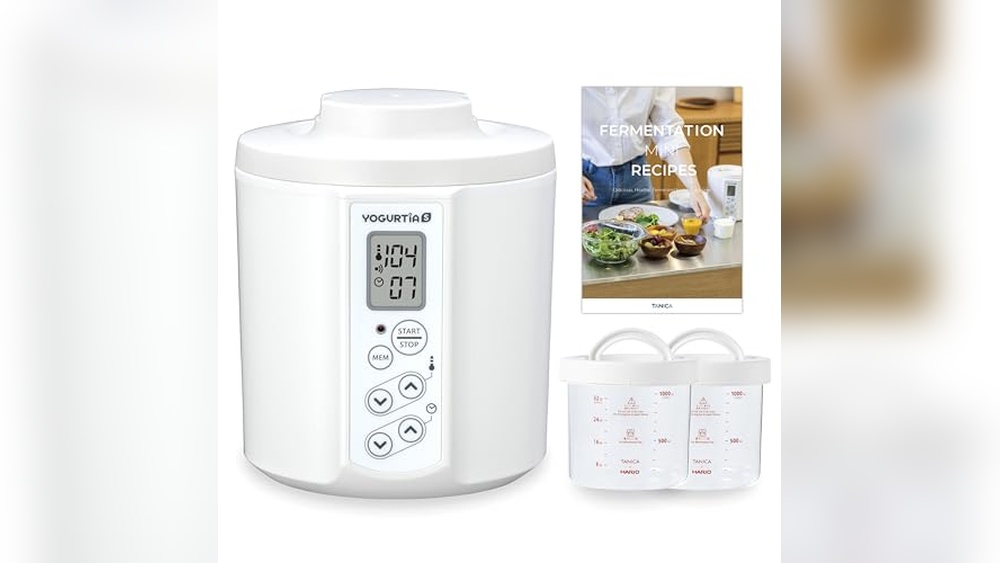
| Model | Yogurtia S, English model (100V–240V worldwide voltage) |
| Temperature range | 25°C to 70°C (77°F to 158°F), in 1° steps |
| Timer | 10 to 50 minutes, or 1 to 48 hours |
| Capacity | 1,100 ml (39 oz) per glass pot; two pots included, one runs at a time |
| In the box | Main unit, two glass pots, recipe book |
| Power | 30 W, 100V to 240V, Type A plug |
| Size | 6.3 in wide × 7.4 in tall (160 × 188 mm) |
| Weight | About 1.7 lb main unit (760 g) |
| Made in | Japan; glass pots developed with HARIO |
Lab Testing Results
| Test recipe | Target | Timer | Measured | Result |
|---|---|---|---|---|
| Bulgarian yogurt | 42°C (107°F) | 7 hours | 42.1°C ± 0.3°C | Firm, smooth curd, minimal whey |
| Rice amazake | 60°C (140°F) | 6 hours | 59.8°C ± 0.4°C | Very sweet, full starch conversion |
| Miso koji | 30°C (86°F) | 24 hours | 30.2°C ± 0.2°C | Active koji growth, rich aroma |
| Onsen tamago | 65°C (149°F) | 30 minutes | 65.0°C ± 0.5°C | Silky whites, warm liquid yolks |
Lab conditions: 71°F (21.5°C) kitchen, calibrated digital probe in the center of the glass pot. Power draw averaged 30 W while heating.
TANICA rates the controller at ±3°C, so our unit did far better than its own spec. The biggest swing in any test was half a degree, at the hottest setting.
Performance
Yogurt
We stirred two tablespoons of store-bought yogurt into pasteurized whole milk, set 42°C for 7 hours and pressed start. The pot sits deep in a snug heated well, and heat reached the milk evenly.
The result was a glossy, uniform set with no scorched layer at the bottom and very little whey. That is the kind of even set cheap fixed-temperature makers often miss.
Amazake
Amazake is where the YOGURTiA earns its price. Koji enzymes turn rice starch into sugar best at about 60°C. Much cooler, and the mash works slowly and can turn sour. Much hotter, and the enzymes start to break down.
The YOGURTiA held the mash at 59.8°C for six hours. We got a rich, naturally sweet rice porridge with no burnt patches and no added sugar.
Miso Koji
At the bottom of its range, the unit held 30.2°C for a full 24 hours with only ±0.2°C of drift. The koji showed active growth and a strong, sweet aroma by the end.
Onsen Eggs
Fill a glass pot with water, add raw eggs, and run 65°C for 30 minutes on the short timer. Our test kit came with an egg stand, but the current Amazon listing does not include one, and the eggs cook just as well resting in the water. The eggs came out with soft, just-set whites around warm, runny yolks.
Onsen eggs are not fully cooked. The USDA advises pasteurized eggs for young children, pregnant people and anyone with a weak immune system.
Design and Build Quality
The main unit is small and light. It takes up less counter space than a two-slice toaster and fits under upper cabinets. The control panel is simple: two temperature buttons, a timer and start. Press both temperature buttons together to switch between °C and °F. If you’re weighing whether a fermenter earns its counter space, our small kitchen appliances list puts it next to the other machines.
TANICA developed the glass pots with HARIO, the Japanese heat-resistant glass maker. After weeks of testing, they came out of the top rack of our dishwasher clear, with no cloudy film or sour-milk smell, which plastic tubs often keep. We washed the plastic lids by hand.
The exterior wipes clean with a damp sponge. A completion buzzer sounds at the end of each cycle, and you can turn it off for overnight runs.
What Could Be Better
- One pot at a time. The kit includes two 1,100 ml glass pots, but the heater holds only one. The second pot is for prepping the next batch or storing the last one in the fridge, not for doubling output.
- Price. At about $250, it costs roughly five times a basic yogurt maker. You are paying for the 25°C to 70°C range and the precision.
- Plug. The voltage works worldwide, but the Type A plug needs an adapter outside North America and Japan.
How It Compares
| Feature | TANICA YOGURTiA | Euro Cuisine YM80 | Dash Greek Yogurt Maker |
|---|---|---|---|
| Price | About $250 | Under $50 | Under $50 |
| Temperature control | Adjustable, 25°C to 70°C in 1° steps | Fixed, not adjustable | Fixed, not adjustable |
| Timer | 10–50 min or 1–48 hr, stops automatically | Reminder dial only, no auto shut-off | Digital, 8-hour default, 30-minute steps |
| Vessels | Two 1,100 ml glass pots (one at a time) | Seven 6 oz glass jars | Large (1 qt) and small containers plus Greek strainer |
| Best for | Koji, amazake, miso, natto and yogurt | Single-serve yogurt jars | Strained Greek yogurt |
The Euro Cuisine and Dash machines are good, cheap yogurt makers, but neither can reach amazake or koji temperatures. For long-ferment yogurt in bigger batches, see our FermentPro 12.8L review. To try yogurt before buying any machine, here is how to make yogurt in an Instant Pot.
Who Should Buy It
- Buy it if you make Japanese ferments such as amazake, shio koji, miso or natto, or you want exact temperature control for small yogurt batches.
- Buy it if counter space is tight. It is one of the smallest fermenters you can buy.
- Skip it if you go through more than a liter of yogurt a week, or you just want plain yogurt for the lowest price.
Temperature and Time Cheat Sheet
| Food | Temperature | Time |
|---|---|---|
| Yogurt | 42°C (107°F) | 7 to 8 hours |
| Greek yogurt | 42°C (107°F) | 7 to 8 hours, then strain |
| Amazake | 60°C (140°F) | 6 to 8 hours |
| Miso koji | 30°C (86°F) | About 24 hours |
| Natto | 45°C (113°F) | Follow the recipe booklet |
| Onsen eggs | 65°C (149°F) | 30 minutes |
| L. reuteri yogurt (not tested here) | 37°C (99°F) | Up to 36 hours |
All times except L. reuteri come from our tests or TANICA’s guidance. The 48-hour timer covers long ferments, but we did not test L. reuteri in this unit.
UK, Canada and EU Buyer Notes
- UK and Ireland: The YOGURTiA runs on 100V to 240V, so it works on 230V mains without a voltage converter. You only need a plug adapter for its Type A plug. Imports may add VAT and customs charges at delivery.
- Canada: The Type A plug fits Canadian outlets directly. Check the final shipping and import cost at checkout.
- Germany, France, Italy and Spain: Use a simple Type C or F plug adapter. The display defaults to Celsius, and every setting in this review is given in °C first.
- Ingredients: Koji rice is sold as Koji-Reis in Germany and riz koji in France. Asian grocers across Europe also stock dried koji for amazake.
Final Verdict of Our TANICA Yogurtia Review
| Category | Score |
|---|---|
| Temperature accuracy | 9.5/10 |
| Versatility | 9.5/10 |
| Build quality | 9.0/10 |
| Capacity | 7.5/10 |
| Value | 7.5/10 |
| Overall | 8.6/10 |
The TANICA YOGURTiA is a precision tool. It held every target within half a degree, covers the full range from koji to amazake, and stays clean and odor-free. Its limits are batch size and price. For small-batch Japanese fermenting, it is the one we would buy.
Check Price on AmazonFrequently Asked Questions
Can you run both glass pots in the TANICA Yogurtia at once?
No. The heater holds one 1,100 ml pot at a time. The second pot lets you prep the next batch or store the last one while the first is fermenting.
Does the TANICA Yogurtia work in the UK and Europe?
Yes. It runs on 100V to 240V, so you only need a plug adapter for its Type A plug, not a voltage converter.
What temperature should I use for amazake?
Use 60°C (140°F) for 6 to 8 hours. In our test, the YOGURTiA held 59.8°C ± 0.4°C for six hours and made a very sweet amazake.
Can the TANICA Yogurtia make L. reuteri yogurt?
Its 25°C to 70°C range covers the usual 37°C, and the timer runs up to 48 hours. We did not test L. reuteri in this unit, so see our FermentPro review for a tested option.

Reviewed by Nathan Miller, Chief Editor & Kitchen Equipment Expert. Nathan has cooked for more than ten years, has reviewed kitchenware for The Kitchenware Journal since 2022, and covers cast iron and stainless cookware, Dutch ovens, woks, multi-cookers, fermentation gear and measuring tools. Our lab logs fermentation temperatures with a calibrated thermocouple data logger. He previously cooked professionally in restaurants in South Korea, Saudi Arabia and the US. How we test.