Last Updated on August 18, 2026
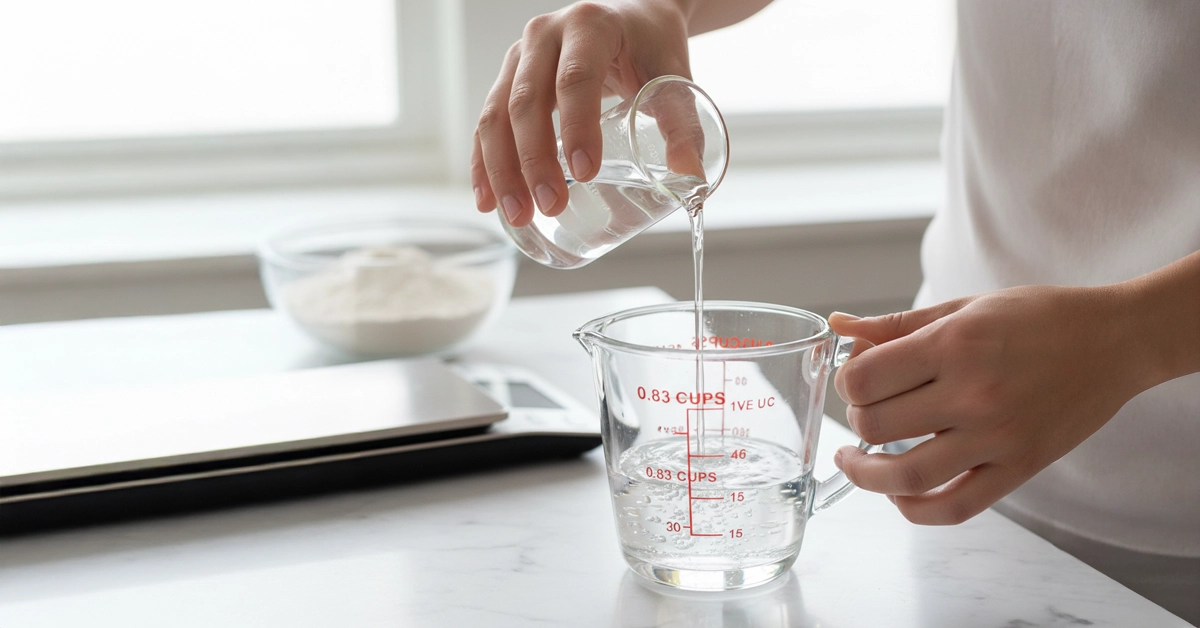
That’s right—200 ml to cups is precisely 0.83 U.S. Customary Cups. Whether you’re measuring milk for a fluffy stack of pancakes or simply tracking your daily water intake, knowing this exact conversion matters. The difference between the metric system and U.S. cups is confusing enough to frustrate even the most experienced home cook. Stop guessing and risking your ingredients!
We know you came for a quick answer, and we’ve put the full conversion table right below. This isn’t just a quick number, though. This comprehensive guide will teach you the exact formula, explain the various cup sizes used worldwide, and show you the best tools to master accurate measuring for good.
Table of Contents
Quick Conversion Chart: 200 ml to Cups
There are two most common ways people define a U.S. Customary cup:
1. The Scientific/Precise Definition: 1 U.S. cup ≈236.6 ml, and
2. The Kitchen/Practical Definition: 1 U.S. cup ≈is approximately 240 ml.
The 240 ml standard is more convenient for general kitchen math and is what is typically marked on most measuring cups.
We use the standard kitchen measurement of 240 ml for easy calculation and convenience for our native readers.
| Conversion Basis | Calculation (200 ml÷X) | Result |
| Precise (236.6 ml) | 200÷236.6 | ≈0.845 cups (This is where the 0.85 came from) |
| Practical (240 ml) | 200÷240 | ≈0.833 cups (This is where the 0.83 came from) |
Here is the exact breakdown for 200 ml to cups using the standard U.S. kitchen approximation of 1 cup ≈240 ml.
| Milliliters (ml) | U.S. Customary Cups | Metric (Australian/Canadian) Cups |
| 200 ml | 0.83 cups | 0.80 cups |
| 100 ml | 0.42 cups | 0.40 cups |
| 120 ml | 0.50 cups | 0.48 cups |
| 240 ml | 1 cup | 0.96 cups |
| 500 ml | 2.08 cups | 2 cups |
Why Conversions Get Complicated (U.S. vs. Metric)
Ever wonder why recipes from one website turn out perfectly, while another yields a total mess? The problem often boils down to the size of the cup.
Milliliters (ml) are part of the metric system, which is used by most of the world. Cups, on the other hand, are part of the U.S. Customary system.
The most frustrating part? There isn’t just one “cup” size!
The Two Main Cup Standards
You must know which cup standard your recipe uses.
- U.S. Customary Cup: This is the size used in nearly all American cookbooks. Technically, it equals 236.588 ml. Most home cooks and packaged goods, however, round this up to a simple 240 ml for more straightforward math. This 240 ml approximation is what you find on most measuring tools sold in the United States. We will use this 240 ml figure for all conversions in this guide.
- Metric Cup: Used in places like Canada, Australia, and New Zealand. A metric cup is defined as a convenient, rounded number: 250 ml.
A person using a U.S. recipe while measuring with a Metric cup will always use slightly too much liquid. That minor difference can absolutely change a delicate dessert.
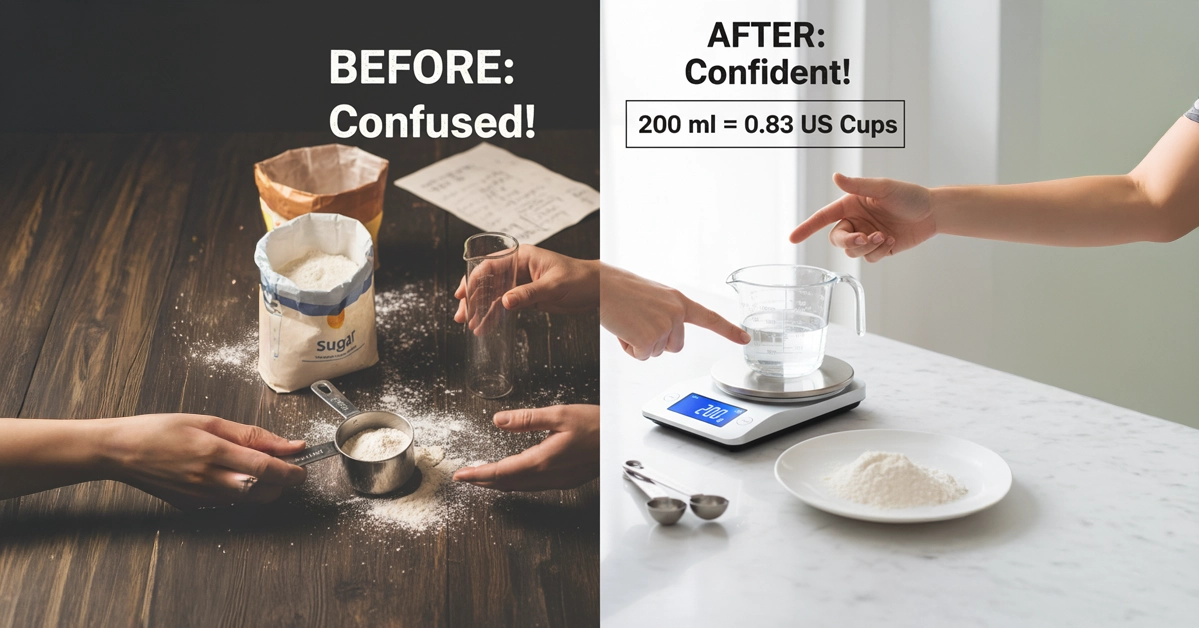
The Simple Formula: Converting Any ml Amount
Converting 200 ml to cups is straightforward if you know the simple division. You can use this formula for any liquid conversion you ever need:
Cups=Milliliters÷Cup Size in Milliliters
The 200 ml Step-by-Step Calculation
Let’s quickly apply the formula using the most common U.S. kitchen standard: 240 ml per cup.
- Start with your amount: 200 ml.
- Divide by the cup size: 200÷240=0.8333
- The final answer: 200 ml is 0.83 cups.
That result is very close to 3/4 cup (which is 0.75 cups). For simple cooking tasks, such as making sauces or smoothies, using a heaping 3/4 cup is an acceptable approximation. You should use a calculator and measure exactly for baking, though.
Tackling Metric Recipes: 150 ml and 300 ml
Many international recipes use rounded metric amounts that aren’t 200 ml. Here are quick conversions for other common metric volumes you might see:
| Metric Volume | Calculation | U.S. Cups (240 ml) | Common Fraction Approximation |
| 150 ml | 150÷240 | 0.63 cups | Just over 1/2 cup |
| 300 ml | 300÷240 | 1.25 cups | 1 and 1/4 cups |
The Density Dilemma: When ml Does Not Equal Grams
Your 200 ml to cups conversion works perfectly for water and most thin liquids. But what happens when you pour 200 ml of honey? That same volume is suddenly much heavier than water.
This is the Density Dilemma. Different ingredients have different weights, even if their volumes are the same. Experienced cooks measure these ingredients by weight (grams or ounces), not volume (ml or cups), to ensure accuracy.
200 ml in Weight for Common Ingredients
Here is how 200 ml of volume translates into weight for everyday kitchen staples:
| Ingredient | Density | Weight of 200 ml |
| Water | Standard | 200 grams |
| Milk | Slightly heavier | 206 grams |
| Honey / Syrup | Very heavy | ≈280 grams |
| Vegetable Oil | Lighter | ≈185 grams |
As you can see, 200 ml of oil weighs 15 grams less than 200 ml of water! Use the weight, not the volume, for these.
Dry Ingredients: The Biggest Headaches
Flour, sugar, and cocoa powder are easily compressed. If you scoop flour directly from the bag, you could end up with 20% too much flour in your cup.
- Never try to convert 200 ml of flour to a cup. Always weigh it.
- 200 ml of water is 200 grams. 200 ml of properly measured flour is only about 100 grams.
The Best Tools for Measuring 200 ml Accurately
The highest-ranking food bloggers and professional chefs all agree: accurate measurements start with the right gear. Forget the old plastic cups that have faded markings!
1. The Digital Kitchen Scale
Seriously, this is your secret weapon. Since 1 ml of water is almost exactly equivalent to 1 g (gram), good digital kitchen scales can convert liquids and solids with pinpoint accuracy.
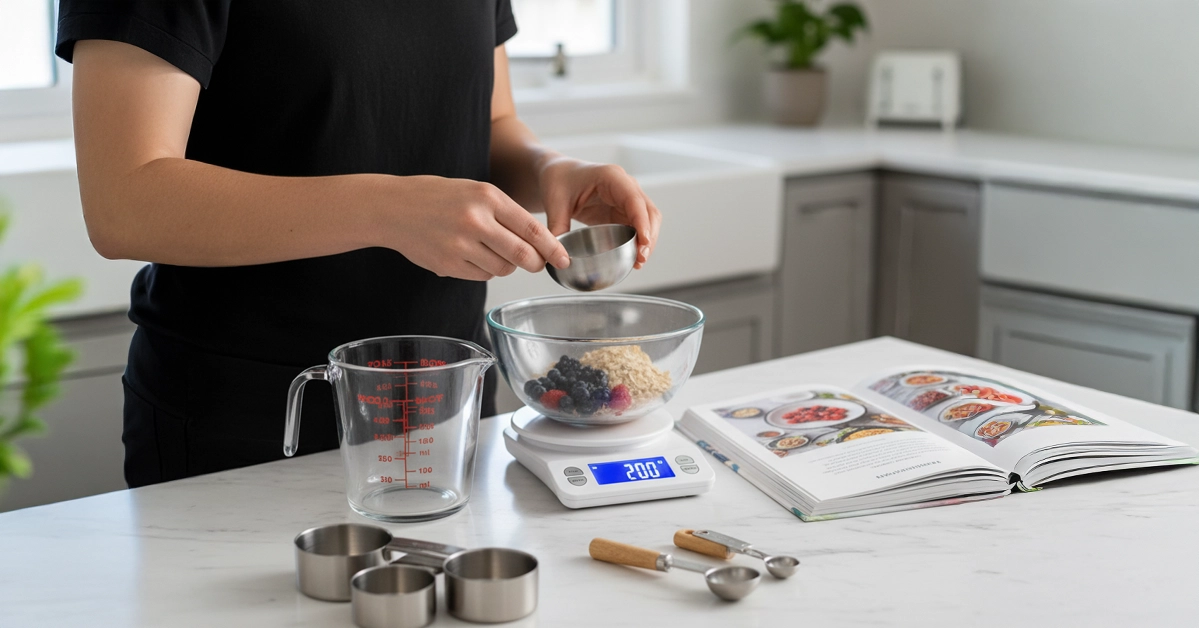
- How to use it: Put a measuring cup or bowl on the scale. Press the “tare” button to reset it to zero. Add 200 grams of water. That is your 200 ml! This trick eliminates the issues of density and varying cup standards.
2. Liquid vs. Dry Measuring Cups
You must use the right cup for the right job. They are designed differently for a reason.
- Liquid Measuring Cups: These are typically made of clear glass or plastic. They have a spout for easy pouring and extra space above the 1-cup line to prevent spills.
- Dry Measuring Cups: These are typically made of solid metal or plastic and are designed to be filled to the brim, then leveled off with a straight edge.
Troubleshooting: Measurement Mistakes to Avoid
Scooping Flour: Never scoop flour directly from the bag with your measuring cup. Spoon the flour lightly into the cup, then level the top with a knife.
The Meniscus Problem: The liquid in your cup curves slightly at the top. Always place your cup on a flat counter and check the liquid at eye level. Measure from the bottom of that curve, not the top.
Using the Wrong Cup: Avoid using a liquid cup for flour, as you’ll inevitably over-measure. The lack of a leveling rim makes it impossible to be accurate.
Practical Conversions: Ounces, Tablespoons, and Liters
Knowing that 200 ml to cups is 0.83 helps, but what if your recipe uses other metric or imperial units? Here is how 200 ml translates to other common volumes:
| Measurement | Equivalent to 200 ml |
| Fluid Ounces (U.S.) | 6.76 fl oz |
| Tablespoons (U.S.) | ≈13.5 tbsp |
| Teaspoons (U.S.) | ≈40.5 tsp |
| Liters (L) | 0.20 L |
Frequently Asked Questions
How Many Cups Are In 200 Ml?
200 ml equals approximately 0. 85 cups. One cup holds about 236. 6 ml. This conversion is helpful for cooking and baking.
Is 200 ml the same as 3/4 cup?
No, not exactly, but it’s close enough for most cooking. 200 ml is 0.83 cups, and 3/4 cup is 0.75 cups. The difference is minor, only about two teaspoons.
How much water is in 200 ml?
200 ml of water is 0.83 U.S. Customary Cups. It’s also exactly 200 grams of water.
What is the formula for converting any ml to cups?
You take the ml volume and divide it by 240. For instance, 120 ml to cups is 120 ÷ 240 = 0.5 cups.
Final Thoughts on Conversion
Converting 200 ml to cups doesn’t have to be confusing. You now know the key fact: 200 ml is 0.83 cups.
Keep this simple formula handy and invest in a quality kitchen scale. Understanding the difference between U.S. and Metric cups and knowing when to use weight instead of volume will make every recipe you try turn out precisely as intended. Happy cooking!