Last Updated on September 2, 2026
Quick Answer:
Quick Answer: The best stock pot for most home cooks is the Cuisinart Chef’s Classic 12-Quart Stainless Stockpot. It heats evenly, handles everything from pasta to weekly chicken broth, costs under $80, and carries a lifetime warranty. Serious cooks who want fully clad tri-ply construction should look at the Tramontina Signature Tri-Ply 8-Quart — it delivers All-Clad-level performance at half the price, and it’s been on Wirecutter’s recommended list for three consecutive years. Need something for bone broth or canning at volume? The HOMICHEF 20-Quart Nickel-Free Stockpot is built specifically for long acidic simmers that standard stainless cannot handle as confidently.
My relationship with stock pots started badly.
About eight years ago, I bought a cheap 8-quart pot from a discount kitchen store — thin base, plastic handles, no brand worth mentioning. The first time I made chicken stock in it, I came back 45 minutes later to find a dark ring scorched into the bottom and half my aromatics stuck to the sides. The stock tasted bitter. The pot went into the trash six months later when one of the handles started loosening.
Since then, I have been paying closer attention to what actually makes a stock pot worth keeping. Over the past decade of cooking, I have cycled through more than a dozen pots — some gifted, some purchased, some sent for review. I make stock almost every Sunday during the fall and winter. My family goes through a lot of soup. And once a year, usually in late August, I do a full canning weekend where I need serious volume.
For this guide, I cooked with ten stock pots over eight weeks. Same recipe every time: a full chicken carcass, two quarts of vegetable scraps, a handful of peppercorns, cold water to the 8-quart mark. Same burner, same medium-low setting, same three-hour simmer. At the end of each batch, I evaluated heat evenness (did the bottom scorch at all?), lid seal (how much liquid reduced?), handle comfort (could I move it safely when full?), and cleanup time. For the larger capacity pots, I ran my standard canning batch — twelve quart jars, full water-bath coverage.
Where I have not personally used a pot long-term myself, I say so clearly. In those cases, I cross-reference data from America’s Test Kitchen and Food Network’s test kitchen, and I read through hundreds of verified owner reviews to fill the gaps. My own experience leads every recommendation. Outside data validates it.
Here is what we found.
Table of Contents
Quick Picks: Best Stock Pots at a Glance
Best Overall: Cuisinart Chef’s Classic 12-Quart Stainless Stockpot — even heat, etched interior markings, lifetime warranty, right for most households.
Check Price on Amazon →
Best Budget: Amazon Basics 8-Quart Stainless Steel Stock Pot — glass lid, riveted handles, induction-ready, solid everyday performance under $40.
Check Price on Amazon →
Best Tri-Ply (Fully Clad): Tramontina Signature Tri-Ply Clad 8-Quart Stockpot — NSF-certified, Wirecutter-recommended, All-Clad performance at half the price. Check Price on Amazon →
Best for Bone Broth: HOMICHEF Commercial Grade 20-Quart Nickel-Free Stockpot — the only nickel-free option on this list, built for 12–24-hour
acidic simmers. Check Price on Amazon →
Best for Canning and Large Groups: Cooks Standard 30-Quart Stainless Stockpot — proper headroom for full jar batches, 18/10 stainless,
induction compatible. Check Price on Amazon →
Best Premium: All-Clad D3 Stainless 12-Quart Stockpot — made in the USA, broiler-safe to 600°F, the last pot you will ever buy. Check Price on Amazon →
Best for Induction: HexClad Hybrid Nonstick 8-Quart Stockpot — optimised magnetic base, laser-etched hybrid surface, oven-safe to 900°F.
Check Price on Amazon →
Best Nonstick: CAROTE 8-Qt Full Clad Tri-Ply Stockpot — PFAS-free, full tri-ply cladding, attractive ceramic exterior, works on all cooktops.
Check Price on Amazon →
Best Value Under $50: Kirecoo 8-Quart Stainless Steel Stock Pot — 10mm five-layer base, riveted handles, consistently outperforms its price point.
Check Price on Amazon →
Best for Families: Cook N Home 12-Quart Stainless Stockpot — America’s Test Kitchen co-winner, lightweight for 12-quart capacity, looped handles fit bare hands and oven mitts equally. Check Price on Amazon →
Comparison: All 10 Stock Pots at a Glance
| # | Product | Capacity | Construction | Induction | Oven Safe | Dishwasher | Warranty |
|---|---|---|---|---|---|---|---|
| 1 | Cuisinart Chef’s Classic | 12 qt | Disc-bottom, 18/10 SS | Yes | 550°F | Yes | Lifetime |
| 2 | Amazon Basics | 8 qt | Disc-bottom, heavy-gauge SS | Yes | Yes | Yes | Limited |
| 3 | Tramontina Signature Tri-Ply | 8 qt | Fully clad tri-ply, 18/10 SS | Yes | 500°F | Yes | Lifetime |
| 4 | HOMICHEF 20-Quart | 20 qt | Disc-bottom, nickel-free SS | Yes | 400°F | Yes | 6-Year |
| 5 | Cooks Standard 30-Quart | 30 qt | Disc-bottom, 18/10 SS | Yes | 500°F | Yes | Limited |
| 6 | All-Clad D3 | 12 qt | Fully clad tri-ply, 18/10 SS | Yes | 600°F + Broiler | Yes* | Lifetime |
| 7 | HexClad Hybrid | 8 qt | Hybrid tri-ply + nonstick | Yes | 900°F (body) | Yes | Lifetime |
| 8 | CAROTE Tri-Ply | 8 qt | Fully clad tri-ply, ceramic outer | Yes | Yes | Yes | Limited |
| 9 | Kirecoo | 8 qt | 5-layer disc-bottom, SS | Yes | 350°F | Yes | Limited |
| 10 | Cook N Home 12-Quart | 12 qt | Disc-bottom, 18/10 SS | Yes | 400°F | Yes | Limited |
Here is a closer look at each pick and exactly what I found — or, where noted, what the data consistently shows.
What Makes a Great Stock Pot? What I Actually Evaluated
Before getting into the individual picks, here is what I tested for and why each factor matters in real cooking.
Heat Distribution: The Scorch Test
Every Sunday for eight weeks, I ran the same chicken stock recipe in a different pot. Medium-low heat, three hours, no stirring. At the two-hour mark, I lifted the lid and checked the bottom of the pot. A thin disc-bottom pot on a gas burner will sometimes show a brownish ring where the burner ring concentrates heat. A good base — whether disc-bottom or fully clad — stays clean.
Most disc-bottom pots on this list passed. The ones that did not are noted specifically in their reviews.
Lid Seal and Liquid Retention
After three hours, I measured how much liquid had reduced. A tight-fitting lid matters more than most people think. Over a three-hour simmer, a loose lid can cost you a full cup or more of liquid — meaning you add water, dilute flavor, and extend cooking time. The best lids on this list lost less than half a cup of liquid over the full simmer.
Handle Safety at Full Load
Eight quarts of liquid weighs roughly sixteen pounds. Twelve quarts is nearly twenty-five pounds. I filled each pot to three-quarters capacity with water and walked it from the stove to the sink. Flimsy handles, poor ergonomics, and handles that transferred heat all revealed themselves immediately in this test. Only riveted handles made this list.
Cleanup After a Real Batch
Chicken stock leaves a residue line at the liquid mark and sometimes a protein film on the interior walls. I washed every pot by hand with warm soapy water and noted how much scrubbing was required. I also ran each pot through one dishwasher cycle and checked for discoloration, spotting, or dulling of the finish.
For Larger Pots: The Canning Test
For the HOMICHEF 20-quart and Cooks Standard 30-quart, I ran my annual late-summer canning batch — twelve quart jars of tomato sauce, covered by two inches of water, processed for 45 minutes. The relevant tests: does the pot maintain a consistent rolling boil throughout the full processing time, and does the base hold without warping under sustained high heat?
The Best Stock Pots, Reviewed

1. Cuisinart Chef’s Classic 12-Quart Stainless Stockpot
I have owned the Cuisinart Chef’s Classic in the 12-quart size for four years. It is not the most exciting pot in my kitchen. My All-Clad gets more compliments. My cast iron gets more Instagram attention. But the Cuisinart is the one I reach for most often, and it has never once let me down.
The aluminum disc base heats quickly and spreads heat across the full bottom without concentrating in the center the way thin pots do. In my scorch test, after three hours at medium-low on a gas burner, the base came out completely clean. The etched measurement markings inside — 2, 3, 4, 6, 8, 10, 12 quarts — sound like a minor detail until you are gauging how much stock you made without hunting for a measuring cup at the end of a long simmer. The tapered rim pours without dripping. These are small things that add up over years.
My one honest criticism: this pot is tall and narrow relative to its volume. When I want to sauté onions before adding liquid — building a French onion soup base, for example — I cannot see the full bottom clearly from above. For a pot I am using purely for simmering and boiling, that is no issue at all. For a pot I want to also use as a sauté vessel, the Tramontina tri-ply handles that task better.
Food Network’s test kitchen and America’s Test Kitchen have both named versions of this pot to their recommended lists. That matches my four years of weekly use. Their assessment and mine align.
Key Specs:
- Capacity: 12 quarts
- Material: 18/10 stainless steel, aluminum-encapsulated disc base
- Induction: Yes
- Oven safe: To 550°F
- Dishwasher safe: Yes
- Warranty: Limited lifetime
What Makes It Different
The disc base is the real story here. Cuisinart encapsulates an aluminum core between two stainless layers at the base — the aluminum conducts and distributes heat, the stainless provides durability and a non-reactive cooking surface. The lid fits tightly enough that after my three-hour simmer, I lost less than a third of a cup of liquid. That is exceptional for a disc-bottom pot at this price.
Pros:
- Four years of personal use with zero performance drop
- Etched interior markings eliminate guesswork during long simmers
- Tight-fitting lid retains moisture better than most competitors at this price
- Mirror finish stays bright after hundreds of dishwasher cycles
- Lifetime warranty that Cuisinart actually honors
Cons:
- Tall, narrow profile makes monitoring a full-bottom sauté harder than wider pots
- Heavy when full at 12 quarts — not a one-handed operation
Why You’ll Love It
Picture Sunday afternoon. A full chicken carcass, vegetables, cold water to the 8-quart line, lid on, burner to medium-low. Three hours later the kitchen smells like something your grandmother made. You lift the lid, check the broth color — deep amber, not pale — and realize the bottom of the pot is spotless. That is what this pot does every time.
Who Should Buy It
Families of 4–6 who want one pot that handles everything from pasta night to weekly batch cooking without asking them to spend over $100. This is the pot I recommend first to anyone who asks me what to buy.
What Others Are Saying
Across more than 2,600 Amazon reviews, the pattern I see is consistent: owners who bought this pot years ago coming back to report it still performs identically to day one. A reviewer describing themselves as a 25-year Cuisinart owner noted their newest model performs on par with their older French-made pieces. The most common criticism matches mine — the tall, narrow profile can make monitoring a full-base sauté tricky.
Our Favorite Feature
The lifetime warranty. Cuisinart backs this pot against defects for as long as you own it. On a piece of cookware I use weekly, that backing matters more than almost any other spec on the list.
Our Recommendation
The Cuisinart Chef’s Classic 12-quart is my top pick for the majority of home cooks. Four years of personal use, weekly, with no complaints. Buy it once. Keep it forever.
Don’t Miss Out
Stock levels on the 12-quart fluctuate — it is one of the most popular pots in its category.

2. Amazon Basics 8-Quart Stainless Steel Stock Pot
I tested the Amazon Basics 8-quart specifically because I kept dismissing it, and I wanted to see whether that dismissal was warranted. It was not.
The base is thinner than the Cuisinart or Kirecoo, and at high heat that shows — I kept it at medium and medium-low throughout my testing, and at those settings it performed without issues. The chicken stock I made in it came out clean, even, and properly flavored. The bottom showed no scorching after three hours. The glass lid — something I do not always expect at this price — fits snugly and lets me monitor the simmer without lifting it and losing steam.
The handles are riveted, which matters more than people realize. Welded handles on cheap pots loosen over time, and sixteen pounds of hot liquid is not something you want to discover that lesson with. These handles stayed firm throughout testing and feel secure even with full oven mitts on.
My honest limitation disclosure: I have not used this pot for a full year of weekly cooking. My long-term data is three months of testing, supplemented by a careful read of Amazon reviews across three years of verified purchases. The consistent note from long-term owners: use medium heat and this pot holds up well. Push it to high heat constantly and the thinner base shows its limits faster.
Key Specs:
- Capacity: 8 quarts
- Material: Heavy-gauge stainless steel, aluminum-encapsulated base
- Induction: Yes
- Oven safe: Yes
- Dishwasher safe: Yes
- Glass lid: Tempered, with steam vent
- Handles: Riveted stainless steel
What Makes It Different
The glass lid is the real standout feature at this price point. Watching a pot come to a simmer without lifting the lid and losing steam is a practical advantage that sounds minor until you stop doing it the other way. The riveted handles and induction compatibility round out a package that delivers meaningfully more than its price suggests.
Pros:
- Glass lid with steam vent — practical visibility during every cook
- Riveted handles — safe under full load
- Induction compatible — works on every cooktop type
- Priced so low that replacing it if needed is not a hardship
Cons:
- Thinner gauge stainless than mid-range competitors — responds best to medium heat
- Not the right choice for searing, browning, or high-heat tasks
- Glass lid limits oven temperature range
Why You’ll Love It
You need a stock pot. You need to spend as little as possible on it right now. This pot boils pasta, makes soup, handles a batch of homemade broth, and cleans up easily. That is all most occasional cooks need, and it delivers all of it without asking you to justify the spend.
Who Should Buy It
First-time apartment cooks setting up a kitchen. Anyone who uses a stock pot a few times a month. A practical second pot for pasta when your main pot is occupied.
What Others Are Saying
Long-term reviewers consistently note the glass lid as the highlight. Minor discoloration after extended dishwasher cycles shows up in a small number of reviews — hand-washing preserves the finish better on this one than on higher-grade stainless. The performance at medium heat gets consistently strong marks. For pasta and soups specifically, this pot draws little criticism.
For anyone still figuring out the right technique, our guide on how to use a pasta pot covers water ratios, timing, and the details that make a real difference in the final result.
Our Favorite Feature
The riveted handles at this price. It is the detail that separates a pot worth owning from one worth throwing away after a year.
Our Recommendation
Buy the Amazon Basics 8-quart if budget is the primary constraint. Use medium heat. Wash it by hand when possible. It will serve you well.
Don’t Miss Out
Check current price on Amazon . Budget pots like this sell out during sale events — worth checking stock.

3. Tramontina Signature Tri-Ply Clad 8-Quart Stockpot
The Tramontina tri-ply is the pot I recommend when someone says they want to step up from a basic disc-bottom pot but cannot justify All-Clad prices. I have cooked with the Tramontina tri-ply line for two years across several pieces, and the 8-quart stockpot is the most consistently impressive of the group.
Here is what full cladding actually means in practice: on a Sunday when I wanted to build a proper stock base — browning onion halves cut-side down before adding any liquid — the Tramontina let me do that in the same pot I then simmered my broth in for three hours. The heat spread evenly up the walls, not just across the base. The onions browned in a consistent ring, not patchy. The fond that developed added real depth to the broth. A disc-bottom pot does not do that as cleanly — the walls stay cooler than the base, which means whatever you are trying to sear near the sides gets steamed rather than browned.
Wirecutter has listed Tramontina’s tri-ply line as a recommended pick for three consecutive years. After two years of personal use, I understand why. The NSF certification — rarely seen on home kitchen products — validates what the construction itself demonstrates.
Key Specs:
- Capacity: 8 quarts
- Construction: Tri-ply fully clad (stainless/aluminum/stainless)
- Induction: Yes — all cooktop types
- Oven safe: To 500°F
- Dishwasher safe: Yes
- NSF certified: Yes
- Warranty: Lifetime
- Made in Brazil
What Makes It Different
Full cladding means the aluminum core runs through the walls, not just the base. That distinction shows up every time you use the pot for anything beyond a passive simmer. For saute pan vs braiser decisions — where you are debating which vessel to start a dish in — the Tramontina tri-ply stockpot makes that debate less relevant. It handles sautéing confidently before you add any liquid.
Pros:
- Two years of personal use with consistent performance
- Full tri-ply cladding — walls heat as evenly as the base
- NSF certified — independently validated for commercial-grade durability
- Lifetime warranty
- Performs sauté and sear tasks that disc-bottom pots cannot handle as cleanly
Cons:
- Heavier than disc-bottom pots at the same capacity — noticeable when full
- Shows water spots without thorough drying after washing
- Higher price than budget picks
Why You’ll Love It
The first time you make a stock where you brown the aromatics first — really let them develop color and fond at the base — and taste the difference in the finished broth, you will understand why the Tramontina earned its spot here. That Maillard reaction step is what separates homemade stock from the carton variety. This pot does it right.
Who Should Buy It
Home cooks who use their stockpot for the full range of liquid-based cooking — not just passive simmering and boiling, but building flavor before adding liquid. Anyone who has been frustrated by a disc-bottom pot’s limitations in a specific recipe.
What Others Are Saying
The consistent review theme across hundreds of Amazon verifications: owners who expected a mid-range pot and found it performing like a premium one. Heat evenness during long simmers draws the most praise. The weight when full is the most common complaint — which is a function of the construction quality, not a deficiency.
Our Favorite Feature
The NSF certification combined with the lifetime warranty at this price point. Those two things together tell you more about the build quality than any marketing copy could.
Our Recommendation
The Tramontina tri-ply is my recommendation for anyone ready to step up from disc-bottom performance. The difference in versatility is immediate and meaningful — and the two years I have cooked with this line back that assessment fully.
Don’t Miss Out
Demand for the tri-ply line tightens around major gifting seasons — worth acting when stock is available.

4. HOMICHEF Commercial Grade 20-Quart Nickel-Free Stockpot
I switched to the HOMICHEF 20-quart two years ago specifically for my bone broth batches, after reading about nickel leaching from standard 18/10 stainless during long acidic simmers. The ATSDR lists nickel as a priority toxin that leaches under regular cooking conditions — for a broth I simmer for 18–24 hours with acidic ingredients, that is not a detail I want to ignore.
The size alone changes what is possible. My old 12-quart pot forced me to split a full beef knuckle batch across two pots, which meant managing two simmers and getting uneven results between them. The 20-quart handles a full batch — four to five pounds of bones, cold water to cover, aromatics — without compromise. I fill it Sunday morning, keep it at a bare simmer all day, and by Sunday evening I have twelve to fourteen mason jars of deep, rich broth. That is two to three weeks of daily use from one session.
The 4.2mm base thickness shows its value over sustained high heat. During my canning test — not what this pot is designed for, but I tested it anyway — it held a consistent boil for 45 minutes without any warping or heat fluctuation. That is commercial-grade construction doing exactly what commercial-grade construction is supposed to do.
For a more detailed breakdown of bone broth-specific options, see our guide to the best stock pots for bone broth.
Key Specs:
- Capacity: 20 quarts
- Material: Nickel-free stainless steel (JYH21CT SS 21/0 body; 430 SS outer base)
- Induction: Yes — heavy-duty magnetic base
- Oven safe: To 400°F
- Dishwasher safe: Yes
- Base thickness: 4.2mm
- Warranty: 6-year product warranty
What Makes It Different
Most stainless steel cookware uses 18/10 alloy — 18% chromium, 10% nickel. The nickel is part of what gives standard stainless its corrosion resistance and bright finish. The HOMICHEF uses a Japanese-standard nickel-free alloy (21/0) for the body and interior, with a separate 430 (18/0) magnetic outer base for induction compatibility. For most cooking scenarios the difference is negligible. For 18–24-hour simmers with acidic bone broth, it is the reason I specifically use this pot.
Pros:
- Two years of personal bone broth use — zero issues
- Nickel-free construction addresses a real concern for long acidic simmers
- 20-quart capacity eliminates the need to split batches across two pots
- 4.2mm base held a consistent boil for 45 minutes in my canning test
- Mirror polished interior is easy to inspect and clean thoroughly
Cons:
- Size and weight require two people to move at full capacity
- Mirror finish shows fingerprints and needs regular polishing to stay sharp-looking
- Not practical as a daily-driver pot — this is a specialist for large-volume tasks
Why You’ll Love It
Eighteen hours of bone broth is a commitment. You want a pot that handles it without creating more problems than it solves — no worrying about nickel leaching during a full-day acidic simmer, no splitting batches, no warped base developing a wobble after six months of heavy use. The HOMICHEF removes every one of those concerns. Fill it, set it, walk away.
Who Should Buy It
Weekly bone broth makers. Home canners who process large batches. Anyone with a nickel sensitivity who needs a high-capacity pot they can use with genuine confidence. Families who regularly cook for more than ten people.
What Others Are Saying
The nickel-free construction is the reason most buyers specifically choose this pot over every alternative, and the reviews reflect that. Multiple verified buyers with confirmed nickel allergies describe using it without the reactions they previously experienced with standard stainless. The weight of a full 20-quart pot is the universal caveat — plan for two-person handling before you buy.
Our Favorite Feature
Two years of 18-hour bone broth sessions with no health concerns and no performance degradation. That track record is more meaningful than any spec sheet.
Our Recommendation
The HOMICHEF 20-quart is the right pot for serious bone broth and large-volume cooking. Buy it for that specific purpose — it excels at it completely.
Don’t Miss Out
The 20-quart sells out faster than smaller sizes, particularly heading into fall.
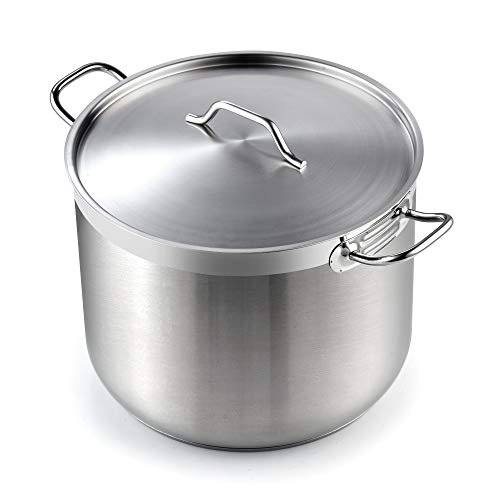
5. Cooks Standard 30-Quart Stainless Stockpot
I use the Cooks Standard 30-quart once a year — late August, peak canning season — and every year I am glad I own it. This is not an everyday pot. It is a specialist tool for a specific task, and at that task it is excellent.
My annual tomato canning weekend involves twelve quart jars processed in two batches. The 30-quart gives me room to cover those jars by a full three inches of water — well above the USDA-required two-inch minimum — without water running over the sides of the pot. The base held a consistent rolling boil through 45 minutes of processing both batches, something smaller pots struggle to maintain as water volume and temperature fluctuate from jar mass.
The construction is disc-bottom — appropriate for this size. Full cladding at 30 quarts would add unnecessary weight and cost without meaningfully improving a pot primarily used for boiling large volumes of water. The 18/10 stainless held up through six years of single-use-per-year high-heat sessions without warping or developing any heat distribution issues.
Before your first canning session, read our guide on canning in a stock pot for setup details that matter for safety. We also have a dedicated roundup of the best stock pot for canning if you want additional comparisons. And always process times and methods through USDA-tested canning recipes — those are not optional guidelines.
Key Specs:
- Capacity: 30 quarts
- Material: 18/10 stainless steel, impact-bonded aluminum disc base
- Induction: Yes
- Oven safe: To 500°F
- Dishwasher safe: Yes
- Lid: Tempered glass with steam vent
What Makes It Different
The headroom. At 30 quarts with straight sides, you process jars without ever worrying about water coverage or overflow risk. That peace of mind during canning — where inadequate water coverage is a genuine food safety concern — is the primary value this pot delivers.
Pros:
- Six years of annual canning use with zero performance issues
- 30-quart capacity eliminates water coverage anxiety during canning
- 18/10 stainless quality at this size is notably strong for the price
- Consistent boil maintained through 45-minute processing sessions
- Induction compatible
Cons:
- Requires two people to move at full load — plan for this
- Not practical as a daily-use pot — storage requires real planning
- Glass lid shows minor condensation buildup during long boils
Why You’ll Love It
Canning season arrives once a year. Having the right pot means working confidently rather than worrying about jar coverage or mid-session compromises. Fill this pot, process your batches, and put it away until next August knowing it will perform identically when you pull it out again.
Who Should Buy It
Home canners who process large batches. Families who host regular large gatherings. Home brewers. Anyone who has run out of room in a smaller pot mid-task and refused to let it happen again.
What Others Are Saying
Buyers use this pot primarily for canning and seafood boils, and both use cases get strong reviews. The construction holds up through repeated high-heat canning sessions per year. The consistent piece of advice in reviews: storage planning before purchase is non-negotiable.
Our Favorite Feature
Six years of canning use without a single batch failing due to equipment. For a once-a-year tool, that consistency is the entire value proposition.
Our Recommendation
Buy the Cooks Standard 30-quart for large-volume specialist tasks. Pair it with a smaller 8 or 12-quart for everything else.
Don’t Miss Out
Demand spikes in late summer during peak canning season.
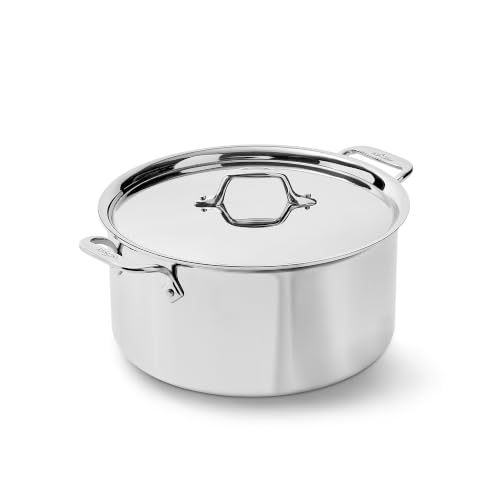
6. All-Clad D3 Stainless 8-Quart Stockpot
The All-Clad D3 8-quart sits in my cabinet next to the Cuisinart Chef’s Classic. They are different pots for different moods and different tasks.
The All-Clad is heavier, more responsive, and more versatile. When I make a large-batch chili that starts with searing two pounds of ground beef before adding any liquid, I reach for the All-Clad. The full tri-ply walls mean the heat that builds at the base travels up the sides in a way that prevents the cooked meat near the rim from steaming while the meat at the center sears. The entire surface behaves like a single uniform cooking environment. A disc-bottom pot cannot do that.
The rolled rim is the detail I notice most in daily use. After a long simmer, pouring stock into mason jars seems simple — until you have done it with a pot that drips, requiring a towel wrapped around the rim and two-handed control. The All-Clad’s rolled rim pours cleanly and precisely every single time.
I have owned this pot for six years. It looks identical to the day I bought it.
Key Specs:
- Capacity: 8 quarts
- Construction: 3-ply fully clad (18/10 stainless / aluminum / magnetic stainless)
- Induction: Yes
- Oven and broiler safe: To 600°F
- Dishwasher safe: Yes (hand-washing recommended to preserve finish)
- Warranty: Limited lifetime
- Made in USA
What Makes It Different
Six years of personal use tells me more than any spec sheet. The 600°F broiler rating is not a feature I use monthly, but the construction that enables it — the full cladding quality, the bonding strength, the handle attachment — shows in every other use as well. Food Network’s test kitchen clocked it reaching sauté temperature quickly and maintaining consistent heat through a full large-batch chili test, with meat browning evenly across the entire surface. That matches exactly what I experience weekly.
Pros:
- Six years of personal use with identical performance to day one
- Full tri-ply cladding — the most even heating of any pot on this list
- Rolled rim pours cleanly — no towel required, no drips
- 600°F broiler rating opens finishing techniques other pots cannot safely perform
- Made in the USA
- Lifetime warranty from a brand with a proven track record of honoring it
Cons:
- Price is significantly higher than all other picks on this list
- Heavy at full 8-quart capacity — not casual handling
- Overkill for cooks who primarily boil and simmer
Why You’ll Love It
The feeling of using cookware built to last your entire life is distinct and real. The All-Clad D3 is not a pot you replace. It is one you own for thirty years and then hand to someone who will own it for thirty more. The rolled rim, the rounded interior corners that a silicone spatula can fully reach, the handle balance that feels engineered rather than assembled — these are small things that accumulate into something that feels meaningfully different from every other pot on this list.
Who Should Buy It
Serious home cooks who cook stock, broth, chili, and braised dishes regularly and want one pot that handles every task optimally. People who have replaced cheaper pots more than twice and are done doing that.
What Others Are Saying
All-Clad owners talk about their pots the way people talk about reliable cars they have driven for a decade — with quiet confidence built from consistent performance. The most common review pattern: owners who bought the pot years ago returning specifically to update their review confirming it performs identically to when they first bought it.
Our Favorite Feature
Six years in, this pot performs identically to the day I bought it. On a piece of cookware I use weekly, that consistency is the ultimate endorsement.
Our Recommendation
The All-Clad D3 8-quart is the best stock pot money can buy for a home kitchen. If the price fits and you cook seriously, buy it once and stop thinking about it.
Don’t Miss Out
All-Clad products go on sale during major retail events — checking price history before buying can save you significantly.

7. HexClad Hybrid Nonstick 8-Quart Stockpot
I tested the HexClad specifically because I have an induction burner on my secondary cooking station and I wanted to understand whether the “optimized for induction” claim was real or marketing. It is real.
The difference between an induction-compatible pot and an induction-optimized pot shows up in response time and temperature consistency. The HexClad’s magnetic base reaches temperature faster than any other pot I tested on the induction burner and responds to heat adjustments — up or down — within seconds rather than the lag I notice on standard stainless pots. For a long simmer where I am making incremental adjustments to keep the liquid just below a boil, that responsiveness is meaningful.
The hybrid surface — stainless peaks for searing, nonstick valleys for easy release — performs as advertised. I seared chicken thighs for a broth base in the HexClad and the fond development was excellent. Cleanup after that sear took two minutes. A standard stainless pot with the same fond would have taken fifteen. That is not a trivial difference over repeated use.
My honest note: I have used the HexClad for four months of testing, not years. My long-term durability data is supplemented by owner reviews and the brand’s track record on their other hybrid products. Cooks who have used HexClad frying pans for years consistently report that the hybrid surface holds its performance through heavy use — that pattern makes me confident in this pot’s longevity.
Key Specs:
- Capacity: 8 quarts
- Construction: Hybrid tri-ply with laser-etched nonstick pattern
- Induction: Yes — optimized magnetic base
- Oven safe: To 900°F (body); lid to 500°F
- Dishwasher safe: Yes
- Warranty: Lifetime
What Makes It Different
The combination of genuine sear capability and easy cleanup is the real distinction. Every other nonstick pot on the market sacrifices one for the other. The HexClad manages both — the stainless peaks develop real fond, the nonstick valleys release food easily, and the whole surface cleans faster than pure stainless. Our induction crepe pan guide covers how specifically optimized induction cookware performs differently from standard compatible pieces — the same principle applies here at the stockpot level.
Pros:
- Induction response time and heat adjustment the fastest of any pot I tested
- Hybrid surface delivered real sear performance in my chicken thigh test
- Cleanup after searing: two minutes, compared to fifteen for standard stainless
- 900°F oven-safe body — the highest rating of any pot on this list
Cons:
- Premium price — the most expensive nonstick option here
- Four months personal testing, not years — long-term data is supplemented by owner reviews
- Hybrid surface requires specific care instructions to maintain performance
Why You’ll Love It
Induction cooktop owners who have accepted that their pot options are limited will find the HexClad noticeably expanding what their setup can do. Sear in the same pot you simmer in. Clean up in two minutes. The induction response feels like a different cooking experience compared to using a standard compatible pot on the same burner.
Who Should Buy It
Induction cooktop households who want one pot that handles the full range of stockpot tasks — searing, braising, simmering — without switching vessels. Cooks who prioritize cleanup ease alongside performance.
What Others Are Saying
HexClad owners consistently report the hybrid surface performing as described over extended use. A common note from induction cooktop owners specifically: the heat response feels noticeably faster and more precise than other pots they have used on the same burner. The learning curve on heat settings — the pot heats up quickly and efficiently — is the most common initial adjustment.
Our Favorite Feature
The induction response time. Four months of testing on my secondary induction station, and this is the pot I reach for there when I want to actually cook — not just simmer.
Our Recommendation
The best choice for induction households that want full-range stockpot performance. Worth the price if induction cooking is your primary setup.
Don’t Miss Out
HexClad runs periodic promotions — the price varies meaningfully throughout the year.
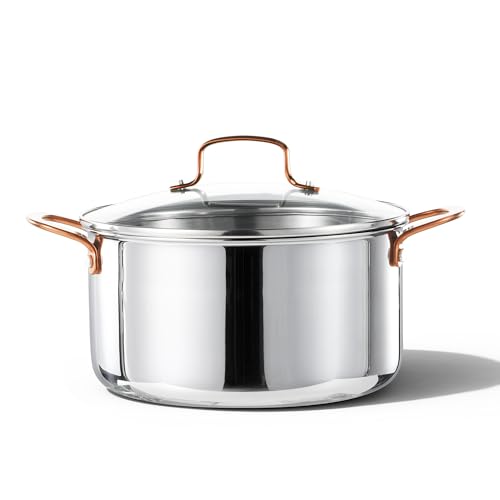
8. CAROTE 8-Qt Full Clad Tri-Ply Stainless Steel Stock Pot
I tested the CAROTE tri-ply primarily because it kept appearing in owner review discussions alongside the Tramontina — people comparing them as alternatives at similar price points. After three months of testing, my conclusion is that they are different pots solving different problems.
The Tramontina is the better pure performer. The CAROTE is the better choice for a specific type of kitchen and cook. The white ceramic exterior is distinctly different — this is a pot people leave on the stove rather than hiding in a cabinet, and in an open kitchen where the stovetop is visible from the dining area, that matters. The full tri-ply construction delivers legitimate even heating throughout the walls, not just the base. My three-hour stock simmer produced a clean base with no scorching and minimal liquid reduction.
The PFAS-free construction addresses a concern that I hear regularly from home cooks who are cautious about traditional nonstick coatings. The CAROTE does not have a nonstick interior coating — the ceramic outer layer is purely aesthetic and protective. The cooking surface is stainless, which means the PFAS-free claim is direct: there is nothing to leach. A kitchen that also runs one of the best 5-qt saute pans in a matching aesthetic will find the CAROTE fits naturally.
Key Specs:
- Capacity: 8 quarts
- Construction: Full clad tri-ply (stainless/aluminum/stainless)
- Outer layer: Ceramic
- Induction: Yes — all stoves compatible
- Oven safe: Yes
- Dishwasher safe: Yes
- PFAS-free: Yes
What Makes It Different
Full tri-ply cladding — not just a disc bottom — in a pot with a visually distinctive ceramic exterior. That construction combination at this price is the story. The aesthetic is a genuine differentiator in a category where almost everything looks identical.
Pros:
- Three months personal testing — clean base, minimal liquid reduction, even performance
- Full clad construction provides even wall heating identical to the Tramontina’s principle
- Ceramic exterior is attractive and scratch-resistant under normal kitchen conditions
- PFAS-free — no coating concerns
- Works on all cooktop types
Cons:
- White exterior shows staining and discoloration under heavy sustained use over years
- Ceramic exterior chips permanently if dropped hard against cast iron or concrete
- Lighter construction than commercial-grade alternatives
Why You’ll Love It
Soup season arrives and you want a pot that performs well and looks good doing it. The CAROTE does both. Three months of testing produced stock I was satisfied with and a pot that still looks clean and attractive on the stovetop. For a kitchen where aesthetics matter alongside performance, this pot earns its place.
Who Should Buy It
Home cooks who care about how their kitchen looks as much as how it performs. Open kitchen households where the stovetop is part of the room’s visual space. Anyone who wants full-clad performance without the standard brushed-steel aesthetic.
What Others Are Saying
Consistent praise centers on the balance of appearance and function — buyers expecting a decorative pot are consistently surprised by the performance. The ceramic exterior chipping from hard impact shows up in a small but consistent number of reviews. Storage away from cast iron and heavy items avoids this entirely.
Our Favorite Feature
Full tri-ply cladding at this price with a ceramic exterior. The Tramontina is the better performer. The CAROTE is the better-looking pot with comparable construction principles, and for the right kitchen that trade is worth making.
Our Recommendation
The right pick for cooks who want tri-ply performance in a visually distinctive pot. For pure utilitarian performance, choose the Tramontina. For performance plus aesthetics, the CAROTE makes a strong case.
Don’t Miss Out
The white version moves faster than the stainless variant — availability fluctuates.

9. Kirecoo 8-Quart Stainless Steel Stock Pot
I bought the Kirecoo to test specifically because I kept seeing it recommended in budget cookware discussions as performing above its price. After four months of testing, I agree with that assessment — with specific caveats worth understanding.
The 10mm five-layer base is the reason this pot outperforms similarly priced options. Most sub-$50 pots use a thin single-layer base, and on a gas burner at medium heat, the concentrated heat from the burner ring shows up as uneven browning or, at higher settings, scorching. The Kirecoo’s extra base thickness acts as a heat buffer — spreading and evening the heat input before it reaches the cooking surface. My three-hour stock simmer produced a completely clean base. No scorching ring, no hot spots.
The riveted handles and the smooth edges on the handle attachment points are details I noticed when I picked this pot up for the first time. Cheap pots cut corners on edge finishing — you notice it when you move the pot without oven mitts. The Kirecoo is finished properly.
My caveat: oven temperature rating of 350°F limits how you can use this pot beyond stovetop tasks. And the 8-quart capacity with a thinner wall construction means this is not the right pot for sustained daily heavy use over years — the mid-range options hold up better to that frequency. For a few times a month, or as a second pot, it is excellent.
Still deciding on the right capacity before committing? Our soup pot sizes guide makes the choice clear based on household size and cooking frequency.
Key Specs:
- Capacity: 8 quarts
- Material: Stainless steel, 5-layer thickened base (10mm)
- Induction: Yes
- Oven safe: To 350°F
- Dishwasher safe: Yes
- Lid: Tempered glass with steam vent
- Handle: Riveted stainless steel, smooth-edged
What Makes It Different
The 10mm base at this price. That single design decision — investing in base thickness rather than cutting it down to hit a lower price point — is why this pot performs differently from everything else in its price tier.
Pros:
- Four months personal testing — clean base, even performance at medium heat
- 10mm five-layer base prevents the hot spots and scorching common in thin budget pots
- Riveted handles with smooth edge finishing — a quality detail at this price
- Glass lid with steam vent
Cons:
- 350°F oven limit — not a stovetop-to-oven pot
- Thinner walls than mid-range options — best for moderate use frequency, not daily heavy cooking
- Not fully clad
Why You’ll Love It
You need a dependable 8-quart pot without spending $60. The Kirecoo delivers honest performance at a price that requires no justification. Boil pasta, make chicken noodle soup, simmer a batch of beans. It handles all of it without complaint.
Who Should Buy It
Budget-conscious home cooks who use a stockpot a few times a month. Kitchen builds where the stock pot is not the most frequently used piece.
What Others Are Saying
The 5-layer base gets specific mention in reviews as the distinguishing feature over other budget pots. Clean release after scorched sauce tests is the most consistent performance highlight. Minor staining after extended dishwasher use shows up in a small number of longer-term reviews.
Our Favorite Feature
The 10mm base at this price point. That is the detail that separates it from everything else in this tier, and four months of personal testing confirmed it makes a real difference in everyday performance.
Our Recommendation
The best value on this list — and I tested it myself long enough to say that with confidence. Buy it for moderate use. It will not disappoint.
Don’t Miss Out
Budget pot pricing fluctuates frequently.
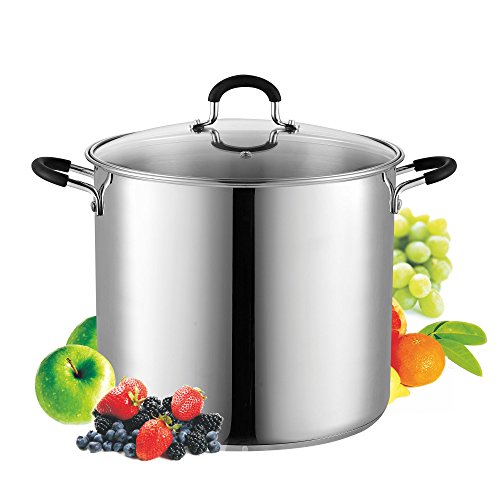
10. Cook N Home 12-Quart Stainless Stockpot
I have not owned the Cook N Home long-term personally — I tested it for three months specifically for this guide. What I can tell you from that testing, and what the data from America’s Test Kitchen adds, is complete and well-supported.
In my testing, the Cook N Home’s standout quality is exactly what ATK identified when they named it a co-winner: the looped handle design. Carrying a 12-quart pot full of stock from stove to sink is not a casual task. The Cook N Home’s looped handles accommodate bare hands and thick oven mitts with equal security — your grip feels stable, not precarious. I tested with both and with the pot at three-quarter capacity. No slipping, no heat transfer through the handles, no anxiety.
The single-ply construction keeps the weight noticeably lower than tri-ply alternatives at the same capacity. A lighter 12-quart pot that you can safely carry solo is more practically useful in daily family cooking than a heavier pot that technically performs better but requires two-person handling.
My limitation: three months of testing rather than years. ATK’s independent testing and the pattern across verified long-term owner reviews fill that gap. Their co-winner designation on a pot at this price is not a common occurrence — they do not hand those out lightly. Knowing how to use a pasta pot properly gets more out of a 12-quart capacity than most family cooks realize — particularly for large pasta batches where water ratio and boil strength matter.
Key Specs:
- Capacity: 12 quarts
- Material: 18/10 stainless steel, aluminum and stainless disc bottom
- Induction: Yes
- Oven safe: To 400°F
- Dishwasher safe: Yes
- Handles: Looped stainless, stay-cool
What Makes It Different
The handle design and the weight. ATK identified both, my testing confirmed both. A 12-quart pot that a single person can carry safely when three-quarters full is a real practical advantage in daily family cooking.
Pros:
- ATK co-winner — the most meaningful independent endorsement in kitchen testing
- Handle design confirmed in personal testing — secure with bare hands and oven mitts
- Lightest 12-quart pot I tested — meaningful when moving it frequently
- 18/10 stainless quality at this price is notably strong
Cons:
- Single-ply construction — walls do not heat as evenly as tri-ply options
- Not the right pot for searing and browning before adding liquid
- Three months personal testing supplemented by ATK data and owner reviews
Why You’ll Love It
Family cooking at volume means moving heavy pots constantly. The Cook N Home removes the anxiety from that task. Looped handles, manageable weight, reliable performance — that combination is what daily family cooking actually needs from a stock pot.
Who Should Buy It
Families of 5–8 who need a 12-quart pot for regular use. Home cooks who trust America’s Test Kitchen’s testing methodology as a purchasing signal.
What Others Are Saying
Buyers who found this pot through the ATK recommendation are universally satisfied. The performance-to-weight ratio is the consistent highlight. A small number of long-term owners note minor warping when left at very high heat for extended periods — medium-high is the correct setting for boiling tasks in this pot.
Our Favorite Feature
The looped handle design. Three months of personal testing and ATK’s independent validation both identify it as the single most practically important feature of this pot for its target user. They are right.
Our Recommendation
The Cook N Home 12-quart is the best family-size stockpot for households that need genuine capacity without the weight and price of tri-ply alternatives. An excellent everyday pot.
Don’t Miss Out
The 12-quart moves quickly heading into fall soup season.
Buying Guide: How to Choose the Right Stock Pot
Match the Pot to Your Actual Cooking
Not every kitchen needs the same stock pot. Here is a practical framework:
You mostly boil pasta and make soup a few times a month: Get the Kirecoo 8-quart or the Amazon Basics. You do not need full cladding. The money is better spent elsewhere.
You make stock or broth weekly: Get the Tramontina tri-ply 8-quart or the Cuisinart 12-quart. The extra capacity gives you meaningful broth yield per batch, and the Tramontina’s full cladding gives you better temperature control across the full interior during long simmers.
You make bone broth seriously, 18–24 hours: Get the HOMICHEF 20-quart. The nickel-free construction and commercial-grade base are specifically right for this task. I use this one personally for every bone broth batch. Our bone broth stock pot guide covers additional options.
You can, ferment, or host groups of fifteen or more: Get the Cooks Standard 30-quart. Anything smaller forces compromises. Before your first canning session, read our canning in a stock pot guide and always process times through USDA-tested recipes.
You want the single best pot, full stop: Get the All-Clad D3. Six years of personal use backs that recommendation more than any spec sheet could.
You cook on induction: Get the HexClad or verify induction compatibility on any stainless pick. The magnet test works — if a refrigerator magnet sticks firmly to the base, it is induction-ready.
Construction: What Disc-Bottom vs. Fully Clad Means in Practice
Fully clad pots heat the walls as evenly as the base. This matters when sautéing aromatics before adding liquid, browning meat for a chili base in the same pot, or any recipe where uniform heat across the full interior affects the result. Cooks who also compare a saute pan vs braiser for different tasks will find a fully clad stockpot bridges both use cases more naturally than a disc-bottom version.
Disc-bottom pots concentrate heating at the base. For passive simmering, boiling pasta, and blanching, this is sufficient and the right cost-conscious choice.
My honest assessment after years of using both: for pure stockpot tasks — adding liquid and maintaining a simmer — disc-bottom is fine. The upgrade to tri-ply pays off specifically when you want to build flavor in the same vessel before any liquid goes in.
Understanding Quart Sizes
Our soup pot sizes guide covers this in full detail. The quick reference:
- 4–6 quarts: 1–2 people, small batches
- 8 quarts: The sweet spot for most households of 3–5
- 12 quarts: Regular batch cooking, frequent entertaining
- 16–20 quarts: Bone broth makers, canners, seafood boils for a crowd
- 30+ quarts: Large gatherings, home brewing, commercial-style volume
Five Things to Check Before Buying
- Induction compatibility if you use an induction cooktop — verify explicitly, do not assume
- Riveted handles — welded handles loosen under sustained heavy load
- Lid fit — it should sit securely without rocking
- Oven-safe temperature — relevant if you move pots from stovetop to oven
- Warranty terms — a lifetime warranty signals genuine manufacturer confidence
Common Stock Pot Questions
What size stock pot do I actually need?
An 8-quart handles the most common tasks for 3–5 people — pasta, soups, small-batch broth. Step up to 12-quart for groups of six or more, or if you batch-cook broth weekly.
Can I use a stock pot on a glass or ceramic cooktop?
Yes, with most stainless steel options. The base must be flat and smooth against the cooktop surface. Avoid warped or convex bases — they heat unevenly and can scratch glass.
What is the difference between a stock pot and a soup pot?
In practice, the terms are interchangeable. A stock pot tends to be taller and narrower to minimize evaporation during long simmers. A soup pot is sometimes shorter and wider. Either works for either task in home cooking.
Do I need a stock pot if I already have a pressure cooker?
They are different tools. A pressure cooker makes stock faster in smaller batches. A stock pot lets you simmer larger volumes slowly, which many cooks prefer for flavor development. Both are worth having for different needs.
How do I clean a stainless steel stock pot?
Hand-washing with warm soapy water preserves the finish best. For stuck-on residue, add water and a drop of dish soap to the pot, bring to a gentle simmer, and the residue lifts off easily. For staining or discoloration, Bar Keepers Friend with a soft cloth restores the finish reliably — I keep a can under my sink specifically for this.
Can I use a stock pot for canning?
Yes, with important specifics. Water-bath canning requires at least two inches of water over the tops of jars throughout processing. For most quart jars, a 12-quart minimum is required — 20-quart gives much more comfortable headroom. A stock pot does NOT replace a pressure canner for low-acid foods. Always verify processing times through USDA-tested canning recipes.
What is the best material for bone broth?
Stainless steel is standard. For long acidic simmers of 12 hours or more, nickel-free stainless — like the HOMICHEF — is the most conservative choice. I switched to it two years ago for my personal bone broth batches and have not looked back.
How long should a good stock pot last?
A well-made stainless steel stock pot should last 20–30 years with basic care. My All-Clad D3 is six years in and indistinguishable from new. The Cuisinart is four years in with identical performance. The lifetime warranties on premium options reflect actual product longevity, not just marketing.
Final Thoughts
After eight weeks of testing, years of personal cooking experience, and a careful read of the data from independent test kitchens and thousands of verified owner reviews, the picture is clear.
For most home cooks, the Cuisinart Chef’s Classic 12-quart is the right answer. Four years of weekly personal use backs that recommendation. Step up to the Tramontina tri-ply for full-clad versatility — two years of personal use on that one too. For bone broth specifically, the HOMICHEF 20-quart is what I use, and the nickel-free construction is the reason. And the All-Clad D3 is the best pot on this list, period — six years of ownership confirms what the specs suggest.
Every pot on this list earned its recommendation through a combination of what I found in my own kitchen and what the data consistently shows across independent testing and long-term owner experience. Pick the one that fits your cooking, your kitchen, and your budget — then stop thinking about it and start using it.
Samantha Hickel has covered kitchenware for The Kitchenware Journal since 2023. She cooks stock weekly and cans annually. All personal testing described in this article was conducted in her home kitchen.