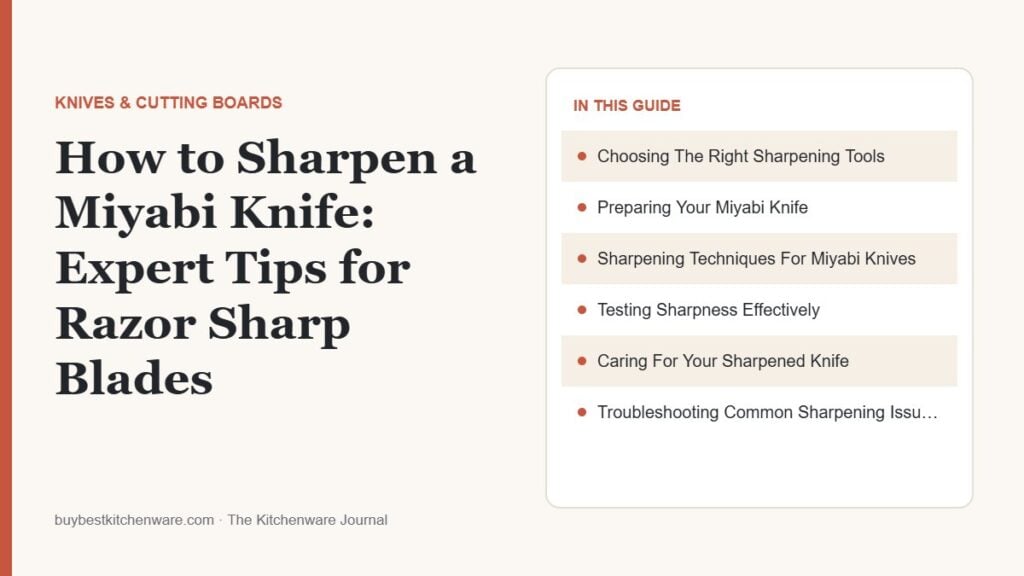

Last Updated on November 15, 2026
The 30-Second Answer: Here’s how to sharpen a Miyabi knife without damaging its thin, hard edge:
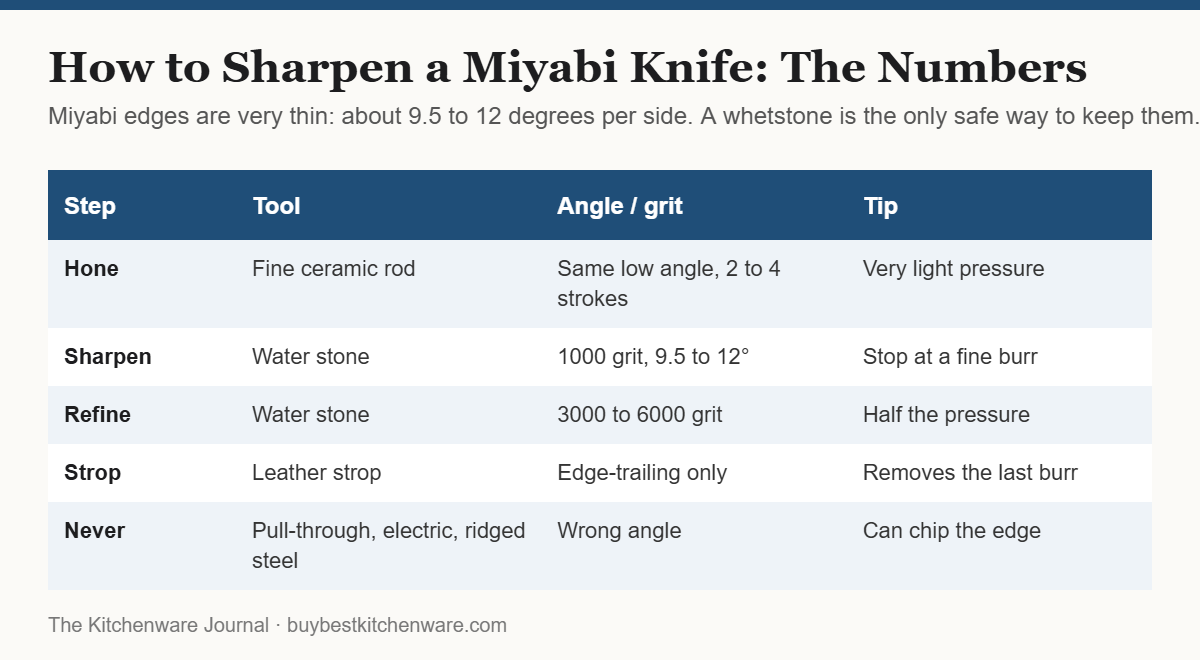
- Use a whetstone only. Miyabi edges are ground at roughly 9.5 to 12 degrees per side, far sharper than most pull-through sharpeners allow.
- Start on 1000 grit, holding a low, steady angle with very light pressure.
- Sharpen until a fine burr forms along the whole opposite side, then switch sides.
- Refine on 3000 to 6000 grit, then strop on leather to remove the burr.
- Between sharpenings, hone with a few gentle strokes on a fine ceramic rod.
Go lighter and slower than you think you need. Hard Japanese steel cuts fast on a stone and chips if forced.
Research note: Angle guidance reflects the very acute edge Miyabi specifies for its Japanese-style knives. Technique follows standard whetstone practice for Japanese kitchen knives.
Miyabi knives are made in Seki, Japan, with very hard steels and some of the thinnest factory edges you’ll find. That’s what makes them glide through food, and why ordinary sharpening tools can ruin them.
This guide shows how to keep that edge: the right angle, a gentle whetstone routine, and the honing habits that stretch time between sharpenings.
In this guide
Why Miyabi Knives Need Special Care
- Very acute angle: about 9.5 to 12 degrees per side, versus 15 to 16 on many Japanese knives and about 20 on German ones.
- Hard steel: many lines use powdered or high-carbon stainless steels in the low-to-mid 60s HRC, which hold an edge for a long time but can chip.
- Thin geometry: great for slicing, not for prying, twisting or cutting bone.
If you also own other Japanese knives, compare with our guide on how to sharpen Shun knives, which use a slightly wider angle.
What You Need
- A 1000 grit water stone
- A 3000 to 6000 grit finishing stone (or a combination stone)
- A non-slip base or damp towel
- A fine ceramic honing rod
- A leather strop (optional, but helpful)
How to Sharpen a Miyabi Knife Step by Step
- Prep the stone. Soak or wet it per its instructions and set it on a stable base.
- Find the angle. Lay the blade flat, then raise the spine just slightly; at 10 degrees, the spine of a chef’s knife sits only about 3/8 inch off the stone.
- Sharpen side one. Edge facing away, sweep heel to tip with light pressure, 10 to 15 strokes.
- Feel for a burr by sliding a finger off (not along) the opposite side.
- Repeat on side two with the same stroke count.
- Refine on the fine stone with half the pressure.
- Strop a few times on leather, edge trailing, to clean up the burr.
- Rinse and dry the knife right away.
Holding very low angles takes practice. Our knife sharpening angle guide has tricks for finding and keeping your angle.
Honing and Daily Care
Hone with a fine ceramic rod, not a ridged steel, using two to four very light strokes per side. Wash by hand, dry immediately, and store on a magnetic strip or in a block, never loose in a drawer. Cut on wood or soft plastic boards, never glass or stone.
Troubleshooting
- No burr forming: your angle may be too low or pressure too light; check with a marker on the bevel.
- Small chips: start on a coarser stone (400 to 600) to repair, then progress up.
- Edge feels sharp but snags: a leftover burr; strop or do a few feather-light passes on the fine stone.
Sharpening Tools for Miyabi Knives
These are the stones and rods we’d pair with a Miyabi.
1. Miyabi Toishi Pro 1000 Grit Whetstone (matched stone)
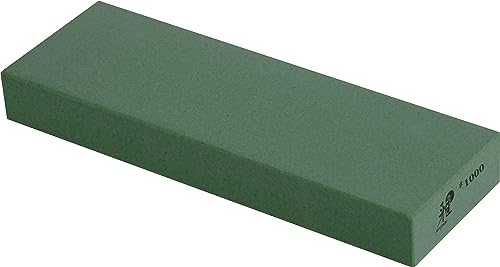
Miyabi’s own Japanese-made 1000 grit water stone.
Why We Like It
Made to sharpen Miyabi steel at its low angle, and 1000 grit is the workhorse for restoring a dull edge.
Flaws to Know
- Single grit; add a finishing stone
- Premium price
Buy it if: you want the maker’s matched stone. Skip it if: you want a budget combination stone.
2. Complete 15-Piece Whetstone Sharpening Kit (all-in-one starter kit)
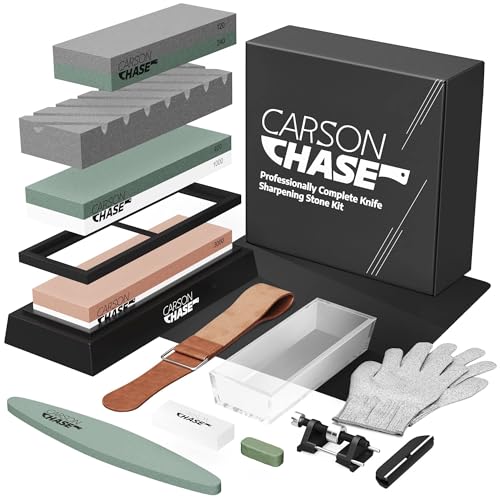
A kit with multiple grit stones, a bowl, base, angle guide and flattening stone.
Why We Like It
Covers coarse repair through fine polishing, so you can handle chips and finish to a high polish without buying pieces separately.
Flaws to Know
- Angle guide may not reach Miyabi’s very low angle
- Lots of parts to store
Buy it if: you’re starting from scratch. Skip it if: you already own good stones.
3. KRAMER by ZWILLING 10-Inch Ceramic Rod (premium ceramic rod)

A 10-inch ceramic sharpening rod from Zwilling, Miyabi’s parent company.
Why We Like It
Fine ceramic is the safe way to hone hard, thin edges between sharpenings.
Flaws to Know
- Pricier than generic rods
- Ceramic can break if dropped
Buy it if: you want a top-quality rod for Japanese knives. Skip it if: you want a budget rod.
4. Kimura 10-Inch Ceramic Honing Rod (budget ceramic rod)
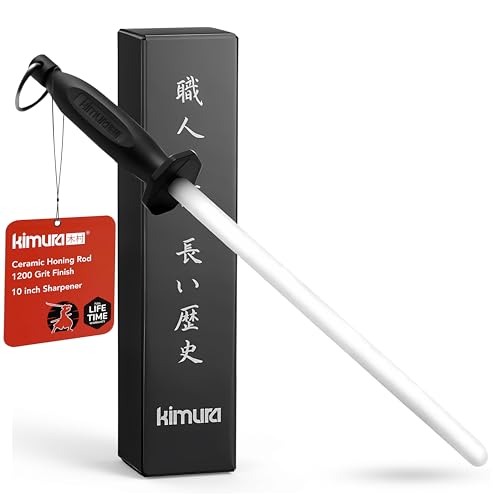
A 1200-grit ceramic honing rod.
Why We Like It
An affordable alternative for gentle honing of hard steel.
Flaws to Know
- Lighter build
- Needs cleaning to remove metal streaks
Buy it if: you want an inexpensive ceramic rod. Skip it if: you prefer a premium rod.
5. SHARPAL Double-Sided Leather Strop Kit (final polish)

A cowhide leather strop block with polishing compound.
Why We Like It
Stropping removes the last of the burr and gives a polished, long-lasting edge on very thin blades.
Flaws to Know
- Edge-trailing technique takes practice
- Compound is messy
Buy it if: you want a razor finish. Skip it if: you’re happy with a stone finish.
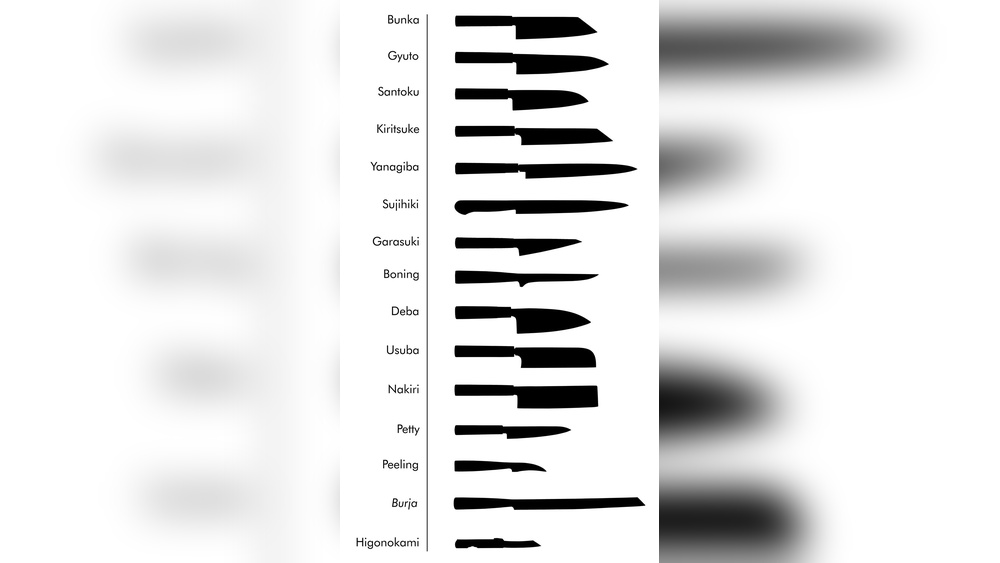
For a closer look at knife styles, see our guide to the types of kitchen knives.
Notes for the UK, Canada and EU
Miyabi is sold across Europe and the UK through Zwilling, which also offers sharpening services in some regions; check your local Zwilling site. UK buyers ordering knives online should expect age verification on delivery. The angle and technique are the same everywhere.
Frequently Asked Questions
What angle do you sharpen a Miyabi knife?
About 9.5 to 12 degrees per side.
Can I use a pull-through sharpener on Miyabi?
No. Most are set at 15 to 20 degrees and can chip the hard, thin edge.
What grit whetstone for Miyabi?
Start with 1000, then refine with 3000 to 6000.
How often should I sharpen a Miyabi?
Every few months for home use, with light ceramic honing in between.
Can I hone a Miyabi on a steel rod?
Use a fine ceramic rod instead of a ridged steel.

Reviewed by Samantha Hickel, Kitchenware Reviewer & Cookware Expert. Samantha has cooked for more than ten years, has reviewed kitchenware for The Kitchenware Journal since 2022, and covers stock pots, saucepans, canning, cake and bread pans, cutting boards and everyday kitchen tools. Our lab tests kitchenware, cutting boards and serving pieces for capacity, durability, stain resistance and ease of care. How we test.
Related guides: What is a whetstone? · Sharpening steel vs ceramic rod · Diamond plate vs stones · Knife sharpness chart