
Last Updated on November 15, 2026
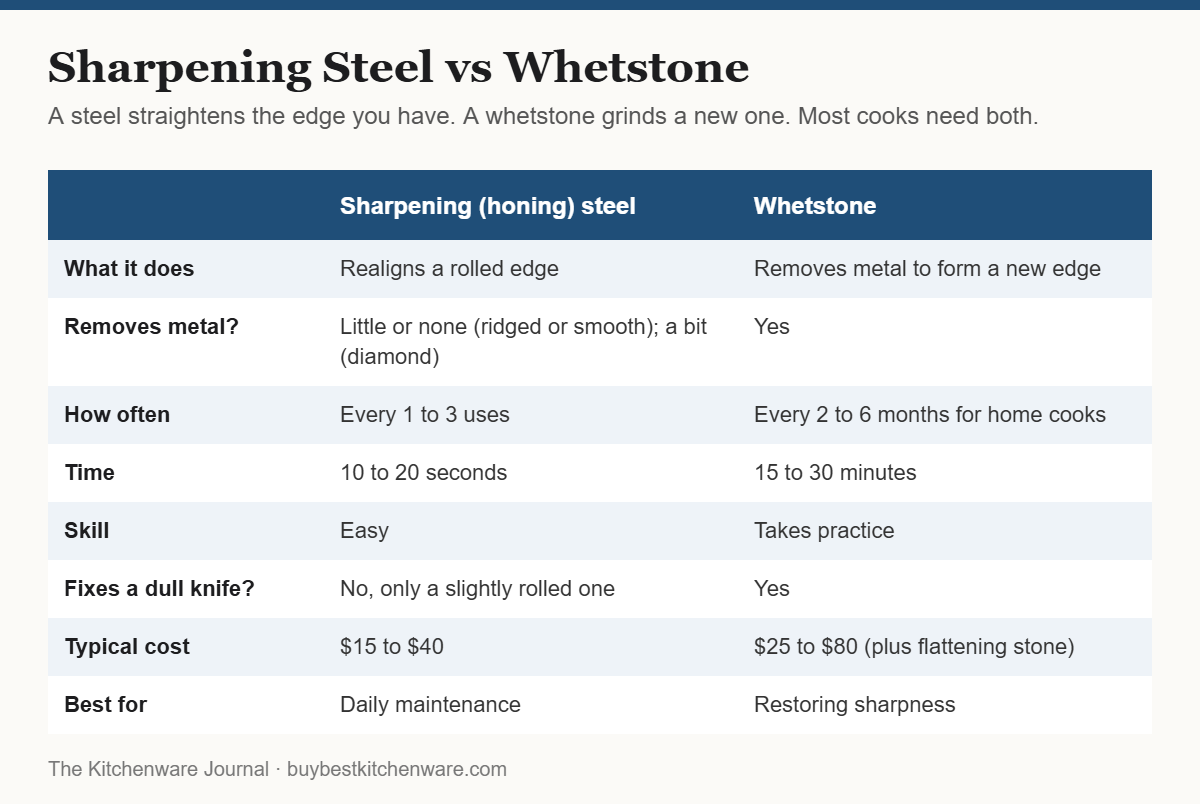
The 30-Second Answer: Sharpening steel vs whetstone isn’t really either-or. They do different jobs:
- A sharpening (honing) steel straightens an edge that has rolled over. It takes 15 seconds and should happen every few uses.
- A whetstone grinds away metal to create a brand-new edge. It takes 20 to 30 minutes and is needed every few months.
- If honing no longer helps, the knife is dull and needs the stone.
- Most home cooks need both: a steel for upkeep and a 1000/6000 grit stone for real sharpening.
- Only buying one? A whetstone, because it can fix a dull knife; a steel can’t.
Despite the name, most “sharpening steels” don’t sharpen. They hone.
Research note: Our comparison follows standard knife-maintenance practice and the basics of honing steels and sharpening stones. Always check your knife maker’s recommended angle.
Your knife block probably came with a steel rod, and every sharpening video seems to use a whetstone. So which one actually keeps knives sharp?
Both, in different ways. This guide explains what each tool does to the edge, how often to use each one, and how to tell which your knife needs right now.
In this guide
What a Sharpening Steel Does
As you cut, the thin edge of a knife bends slightly to one side. The knife feels dull even though the edge is still there. A few strokes on a steel push that edge back into line. Smooth and ridged steels remove little or no metal; diamond-coated and ceramic rods remove a small amount and sit somewhere between honing and sharpening. Our guide to honing rod vs sharpening rod covers those differences, and sharpening steel vs ceramic rod compares the two most common rods.
What a Whetstone Does
A whetstone is an abrasive block that grinds the steel to form a new edge. Coarse grits (around 1000) reshape a dull edge; fine grits (3000 to 8000) refine and polish it. When honing stops working, it’s time for the stone. New to stones? Start with what is a whetstone.
Sharpening Steel vs Whetstone: Which Do You Need Now?
| Your knife… | Use |
|---|---|
| Cut fine last week, feels a bit off today | Steel |
| Slides off tomato skin | Steel first; if no change, whetstone |
| Has a visible chip or flat spot | Whetstone (coarse grit) |
| Hasn’t been sharpened in a year | Whetstone |
| Was just sharpened | Steel to maintain |
Try the paper test: a sharp knife slices cleanly through printer paper. If honing doesn’t restore that, sharpen. Our knife sharpness chart explains other ways to check.
How to Use Each One
Honing with a steel
- Hold the steel vertically, tip on a towel on the counter.
- Place the heel of the knife against the top of the steel at your knife’s angle (about 15 to 20 degrees).
- Draw the blade down and toward you so the whole edge touches the steel.
- Alternate sides, 5 to 8 strokes each, with light pressure.
Sharpening on a whetstone
- Soak or splash the stone as its maker directs.
- Start on the coarse side at a consistent angle; an angle guide helps.
- Push the edge across the stone in sweeping strokes until you feel a slight burr along the opposite side.
- Repeat on the other side, then switch to the fine grit to refine.
- Finish with a few light strokes on a steel to align the edge.
For angle advice by knife type, see our knife sharpening angle guide.
Steels and Stones Worth Buying
A good honing steel plus a combination whetstone covers every home kitchen. Add a flattening stone if you sharpen regularly.
1. Cutluxe 10-Inch Honing Rod (best everyday steel)

A 10-inch high-carbon steel honing rod with an ergonomic handle.
Why We Like It
Long enough for 8-inch chef’s knives, with a comfortable grip for quick daily touch-ups.
Flaws to Know
- Ridged surface can be aggressive on very hard Japanese steel
- Hand wash only
Buy it if: you want a reliable daily steel. Skip it if: you use only hard Japanese knives; choose ceramic.
2. UltraSource Smooth Honing Steel (10 in) (gentlest steel)
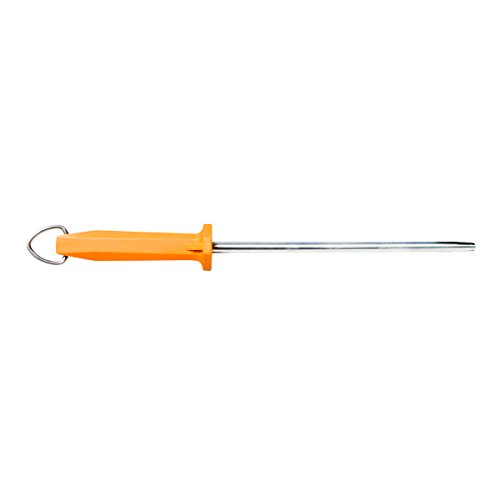
A smooth 10-inch steel used widely in commercial kitchens.
Why We Like It
A smooth surface realigns the edge without removing metal, which is the gentlest way to maintain a sharp knife.
Flaws to Know
- Less effective on a badly rolled edge
- Basic handle
Buy it if: you want gentle, frequent honing. Skip it if: you want a rod that also sharpens a little.
3. Sharp Pebble 1000/6000 Whetstone With Angle Guide (best beginner whetstone)
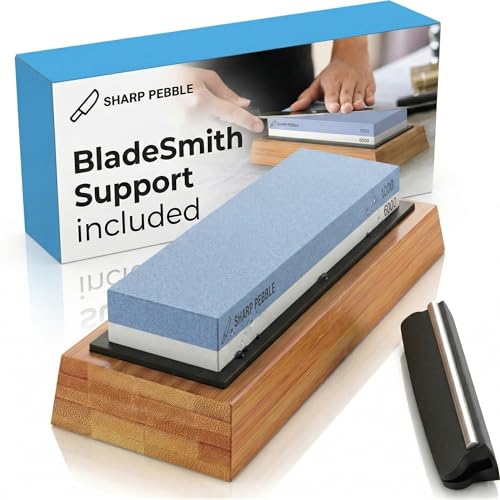
A dual-grit water stone with a non-slip bamboo base and an angle guide.
Why We Like It
1000 grit restores a dull edge, 6000 polishes it, and the angle guide helps beginners hold a steady angle.
Flaws to Know
- Needs soaking
- Will need flattening over time
Buy it if: you’re learning to sharpen. Skip it if: you prefer pull-through sharpeners.
4. KING 1000/6000 Whetstone Starter Set (Japanese classic)

A Japanese-made combination stone with an angle holder and wiping cloth.
Why We Like It
KING stones have been a standard for decades; the 1000/6000 combo is all most home cooks ever need.
Flaws to Know
- Softer stone dishes faster
- Needs soaking
Buy it if: you want a proven traditional stone. Skip it if: you want a splash-and-go stone.
5. Sharp Pebble Flattening Stone (120/320) (keep your stone flat)
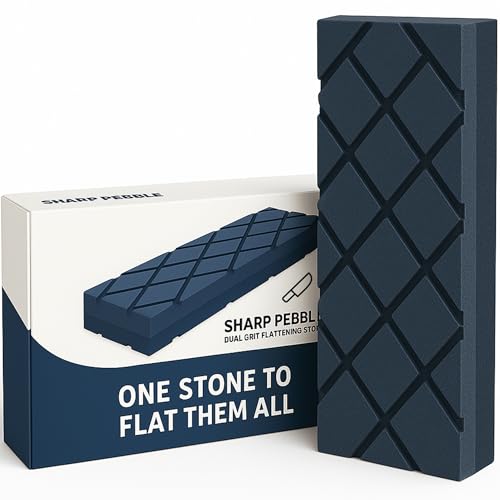
A coarse dual-grit stone for leveling worn whetstones.
Why We Like It
A dished whetstone sharpens unevenly. A few passes on this restore a flat surface.
Flaws to Know
- Only needed if you sharpen often
- Messy slurry
Buy it if: you sharpen every month or two. Skip it if: you sharpen once or twice a year.
For more on knives themselves, see our guide to the types of kitchen knives.
Notes for the UK, Canada and EU
Honing steels are often called “sharpening steels” or simply “steels” in the UK. European knife makers like Wüsthof and Zwilling typically recommend about 14 to 20 degrees per side depending on the line, while Japanese brands sold in Europe go sharper. Whetstones are widely available; in the UK, buyers may be asked for age verification when ordering bladed items, but stones and steels themselves aren’t restricted.
Frequently Asked Questions
Is a sharpening steel the same as a whetstone?
No. A steel realigns an edge; a whetstone grinds a new edge.
Can a honing steel sharpen a dull knife?
No. It only straightens a rolled edge. A dull knife needs a whetstone or sharpener.
How often should I use a whetstone?
Every 2 to 6 months for typical home cooking, or whenever honing stops helping.
How often should I hone?
Every one to three uses, or whenever the knife feels slightly off.
Which should I buy first?
A whetstone if your knives are already dull; a steel if they’re sharp and you want to keep them that way.

Reviewed by Samantha Hickel, Kitchenware Reviewer & Cookware Expert. Samantha has cooked for more than ten years, has reviewed kitchenware for The Kitchenware Journal since 2022, and covers stock pots, saucepans, canning, cake and bread pans, cutting boards and everyday kitchen tools. Our lab tests kitchenware, cutting boards and serving pieces for capacity, durability, stain resistance and ease of care. How we test.
Related guides: How to sharpen a knife with a rod · Diamond plate vs stones · How to sharpen a blunt knife · Coarse vs fine sharpener