
Last Updated on November 15, 2026
The 30-Second Answer: American silversmiths marks usually show the maker’s name or symbol plus a word that tells you the metal. To read one:
- Look on the back of the handle or the base with a loupe and good light.
- Find the Metal Word: STERLING or 925 means solid silver; COIN or PURE COIN means about 90% silver; EP, EPNS or a brand like 1847 Rogers Bros. usually means plate.
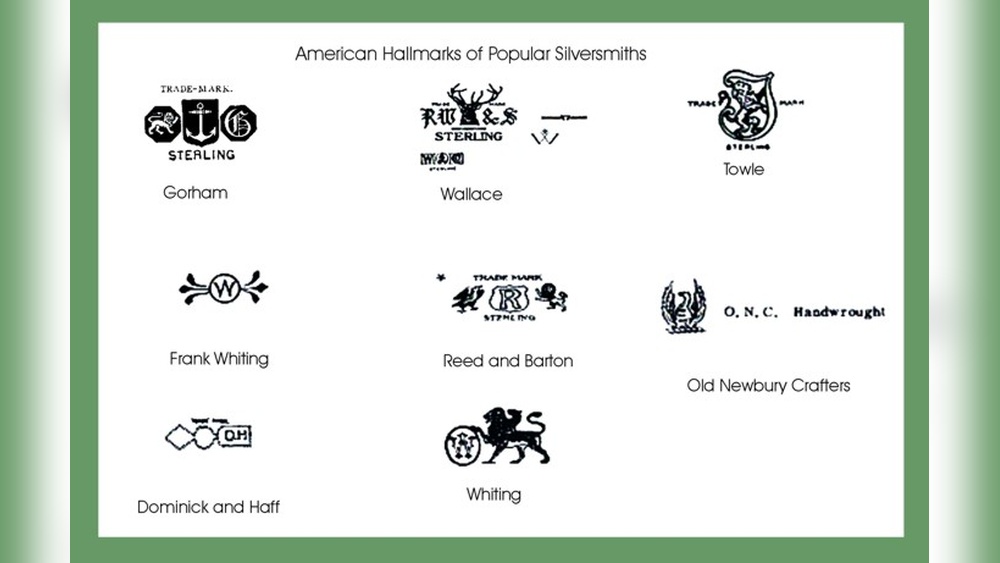
- Identify the Maker: Gorham’s lion-anchor-G, Reed & Barton’s eagle-R-lion, TIFFANY & CO., WALLACE, and so on.
- Note any pattern name, date or numbers; they help date the piece.
- Cross-check in a marks reference before you buy, sell or insure.
Unlike Britain, the US never had a government hallmarking office, so American marks are maker’s marks. That’s why the metal word matters so much.
Research note: Maker details come from standard silver-marks references and maker histories. Purity terms follow the definition of sterling silver (92.5% silver). Care advice follows the Canadian Conservation Institute’s guide to caring for metal objects.
Turn over a spoon from grandma’s drawer and you’ll often find tiny symbols: a lion, an anchor, an eagle, a name in a rectangle. Those are American silversmiths marks, and they can tell you who made the piece, roughly when, and whether it’s solid silver or plated.
This guide focuses on reading maker’s marks from the big American firms. For purity stamps like 925 and EPNS on flatware specifically, see our companion guide to sterling flatware marks.
In this guide
How American Silver Marks Differ From British Hallmarks
British silver carries a set of official hallmarks: a purity mark, a city assay office mark, a date letter and the maker’s mark. American silver doesn’t. Makers marked their own work, so you’ll usually see a name or symbol and, after about the 1860s, the word STERLING. Before that, much American silver was “coin silver” at roughly 90% purity, marked COIN, PURE COIN, DOLLAR or just the maker’s name. Under the National Stamping Act of 1906, items stamped STERLING must be at least 92.5% silver.
Types of Marks on American Silver
- Maker’s mark: a name, initials or symbol (Gorham’s lion-anchor-G).
- Metal or purity mark: STERLING, 925, COIN or 900.
- Plate marks: EP, EPNS, A1, triple plate, quadruple plate or a brand name like 1847 Rogers Bros. or Community.
- Pattern or design marks: a pattern name or number, sometimes a patent date.
- Date marks: some makers, like Gorham, used year symbols you can look up.
American Silversmiths Marks by Maker
Gorham
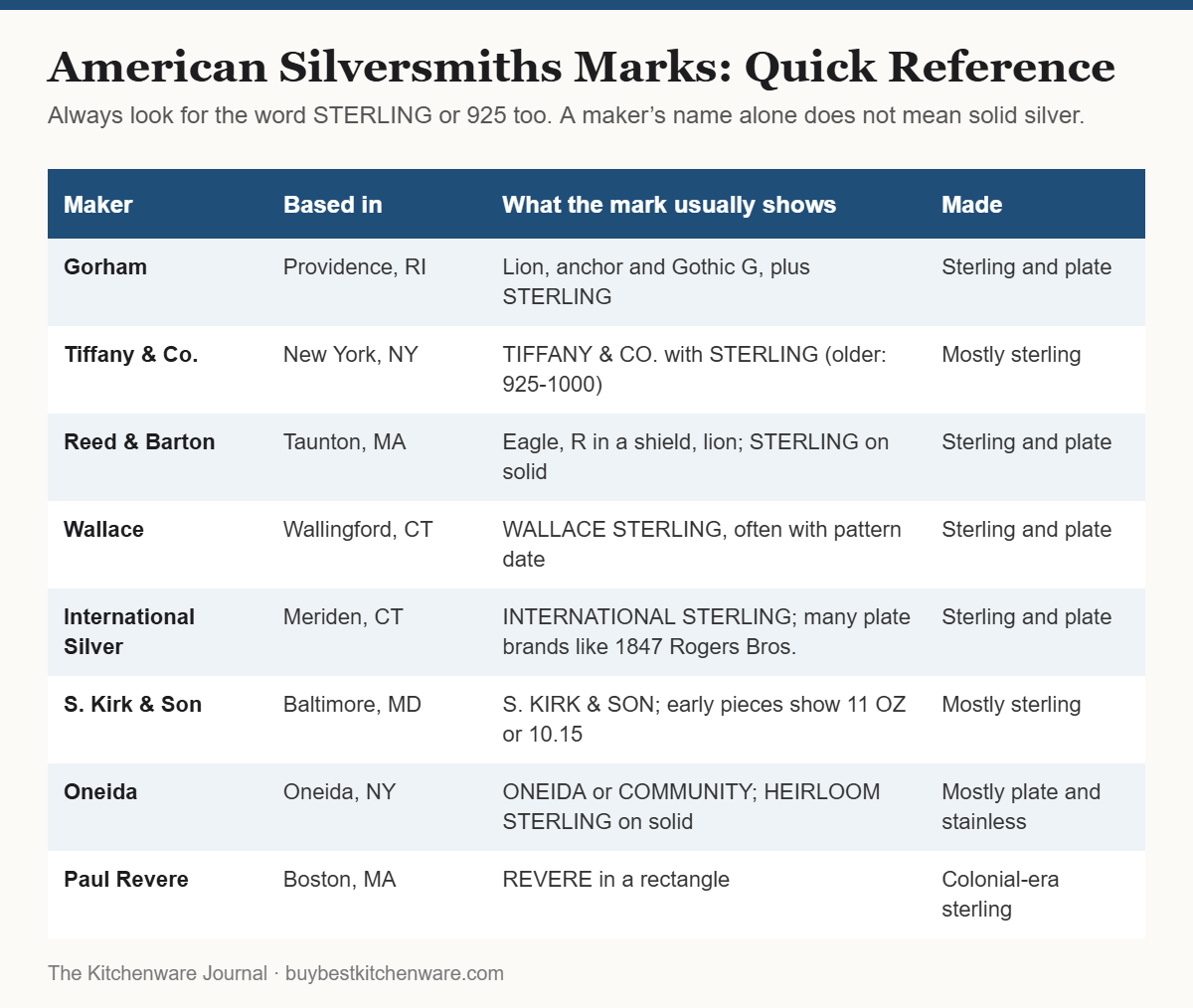
Founded in Providence, Rhode Island, in 1831. Look for a lion, an anchor and a Gothic G, usually with STERLING. Gorham also used date symbols on hollowware from the 1860s onward.
Tiffany & Co.
New York, from 1837. Marked TIFFANY & CO. with STERLING; some older pieces show 925-1000. Earlier hollowware may include a letter for the company president at the time.
Reed & Barton
Taunton, Massachusetts. Their sterling mark shows an eagle, an R in a shield and a lion. They also made a lot of silver plate, so check for STERLING.
Wallace, Towle and International Silver
Wallace (Wallingford, Connecticut) usually marked WALLACE STERLING. Towle (Newburyport, Massachusetts) typically marked TOWLE STERLING, often alongside its lion-and-T emblem. International Silver (Meriden, Connecticut) marked solid pieces INTERNATIONAL STERLING but also owned many plate brands, including 1847 Rogers Bros.
S. Kirk & Son and Paul Revere
Baltimore’s Samuel Kirk marked S. KIRK & SON; early Baltimore silver may show 11 OZ or 10.15, local purity standards. Colonial pieces by Paul Revere carry REVERE in a rectangle and are museum-level rarities; be very cautious with anything claiming his mark.
How to Read a Mark Step by Step
- Clean the area gently with a soft cloth so the stamp is clear.
- Use a 10x loupe in bright, angled light.
- Write down every symbol, word and number in order.
- Check the metal word first; it tells you sterling, coin or plate.
- Match the maker’s symbol in a marks book or reputable online database.
- If you’re still unsure, test it; our guide on how to tell if silverware is real silver covers the magnet, ice and acid tests.
Spotting Fakes and Misleading Marks
- Brand without STERLING: many famous names made silver plate too.
- “Silver” or “German silver”: German silver (nickel silver) contains no silver at all.
- Too-perfect colonial marks: early American silver is rare; fake Revere and Hull marks exist.
- Soft, blurry stamps: cast copies often have mushy marks compared with crisp struck ones.
If it’s plated, the value is mostly in use and design rather than metal. Our silver plate guide explains how plate marks work, and for pricing solid pieces, see is sterling silver worth anything.
Caring for Marked Silver
Polish gently and not too often; every polish removes a little metal and can soften marks over time. Wash by hand in warm, soapy water, dry immediately and store in anti-tarnish cloth. Avoid dips that can strip patina from the recesses around marks.
Tools for Identifying and Caring for Silver
A loupe, a good reference book and a gentle polish cover almost everything you need.
1. American Silversmiths and Their Marks (Dover Edition) (the classic reference)
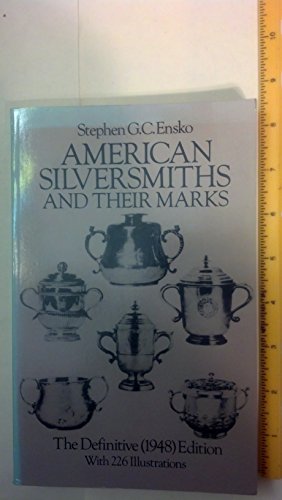
Stephen Ensko’s long-standing reference to early American silversmiths and their marks, in an inexpensive Dover reprint.
Why We Like It
Collectors still use it to match early maker’s marks, and it costs less than a lunch.
Flaws to Know
- Focused on early makers, not modern firms
- Black-and-white line drawings
Buy it if: you’re identifying older American silver. Skip it if: you only have modern flatware.
2. Jewelers Loupe Set (10x, 20x, 30x) (see the marks clearly)
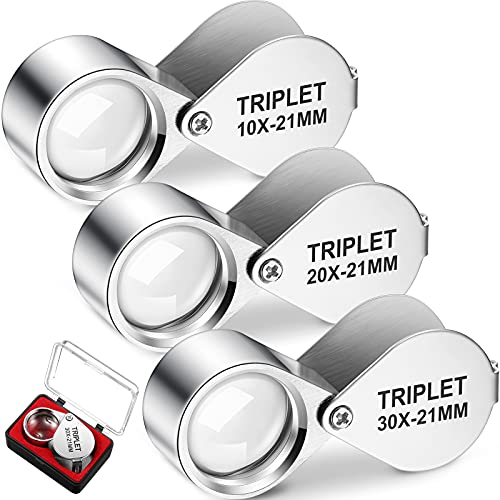
Three folding triplet loupes at 10x, 20x and 30x magnification.
Why We Like It
Most silver marks are tiny and worn. A 10x loupe is the standard for reading them, and the stronger lenses help with blurry stamps.
Flaws to Know
- 30x has a narrow field of view
- Need good light
Buy it if: you’re checking marks on flatware or hollowware. Skip it if: you already have a loupe.
3. Hagerty Silversmiths’ Polish (gentle polish)

A professional-grade silver polish and tarnish remover with anti-tarnish protection.
Why We Like It
Fine polish that brings up the shine without scrubbing away crisp marks, and it leaves a tarnish barrier.
Flaws to Know
- Messy on intricate patterns
- Rinse food-contact pieces well
Buy it if: you want to clean marked silver safely. Skip it if: you prefer polishing cloths only.
4. Bonison Large Silver Polishing Cloths (3 Pack) (quick touch-ups)
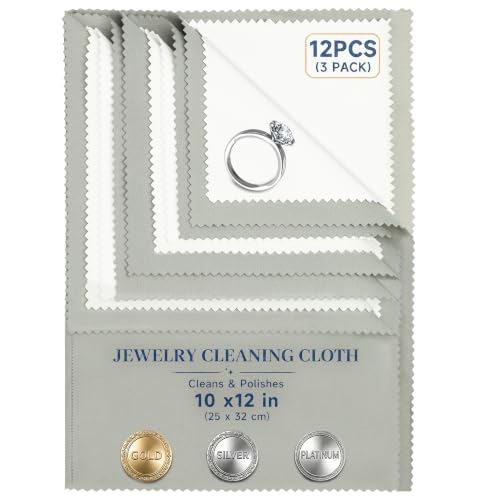
Three 10 x 12-inch treated cloths for silver and jewelry.
Why We Like It
Removes light tarnish between deeper cleanings with no liquids, which is kind to stamped areas.
Flaws to Know
- Turns black as it works
- Not for heavy tarnish
Buy it if: you want easy maintenance. Skip it if: your silver is heavily tarnished.
5. Connoisseurs Extra-Large Polishing Cloth (for bigger pieces)

A 14 x 14-inch two-layer polishing cloth.
Why We Like It
The larger size handles trays, bowls and serving pieces more easily.
Flaws to Know
- Single cloth
- Pricier per cloth
Buy it if: you own serving pieces or hollowware. Skip it if: you only polish flatware.
Using your silver at the table? Our table setting guide shows where each piece goes.
Notes for the UK, Canada and EU
British silver uses official hallmarks: a lion passant for sterling, a city mark (London’s leopard head, for example), a date letter and the maker’s mark. Many EU countries mark silver with numeric fineness like 800, 830 or 925. Canadian silver often reads STERLING with the maker’s name, similar to US practice, and Birks is a common Canadian maker. If you’re buying American silver abroad, look for STERLING rather than a hallmark set.
Frequently Asked Questions
How do I identify American silver marks?
Look for the maker’s name or symbol and a metal word like STERLING, COIN or EPNS, then match the maker in a marks reference.
What does a lion, anchor and G mean on silver?
That’s Gorham, of Providence, Rhode Island.
What does an eagle, R and lion mean?
That’s Reed & Barton’s sterling mark.
Is American silver hallmarked?
Not officially. The US had no assay office system, so American silver carries maker’s marks and purity words.
What is coin silver?
Silver at about 90% purity, used in America before sterling became standard. It’s often marked COIN or PURE COIN.
Does 1847 Rogers Bros. mean sterling?
No, it’s a silver plate brand.

Reviewed by Samantha Hickel, Kitchenware Reviewer & Cookware Expert. Samantha has cooked for more than ten years, has reviewed kitchenware for The Kitchenware Journal since 2022, and covers stock pots, saucepans, canning, cake and bread pans, cutting boards and everyday kitchen tools. Our lab tests kitchenware, cutting boards and serving pieces for capacity, durability, stain resistance and ease of care. How we test.
Related guides: Flatware vs silverware · Fancy silverware · Table setting silverware · How to fold a napkin