
Last Updated on November 24, 2026
The 30-Second Answer: There are eight types of knives worth knowing in a home kitchen, but most home cooks use three every day:
- Chef’s knife (8 in): chopping, slicing and dicing; it does 80% of the work.
- Paring knife (3 to 4 in): peeling, trimming and small, in-hand cuts.
- Serrated bread knife (8 to 10 in): bread, tomatoes and anything with a crust or skin.
- Add later: a boning knife, utility knife, santoku, nakiri or carving knife if your cooking calls for it.
- Keep them sharp: hone often, sharpen a few times a year, and cut on wood or plastic boards.
Western knives are usually sharpened near 20 degrees per side and Japanese knives near 15, so match the angle your knife came with.
How we tested: we put a four-piece starter kit through 14 days of daily meal prep: dicing 5 pounds of onions, slicing ripe Roma tomatoes and breaking down dense squash. We measured blade thickness and weight, checked edge retention after 100 strokes on printer paper, realigned the edge with a honing steel, then deliberately dulled the knife on an unglazed ceramic rim and timed a full edge recovery on a whetstone. See our starter kit results.
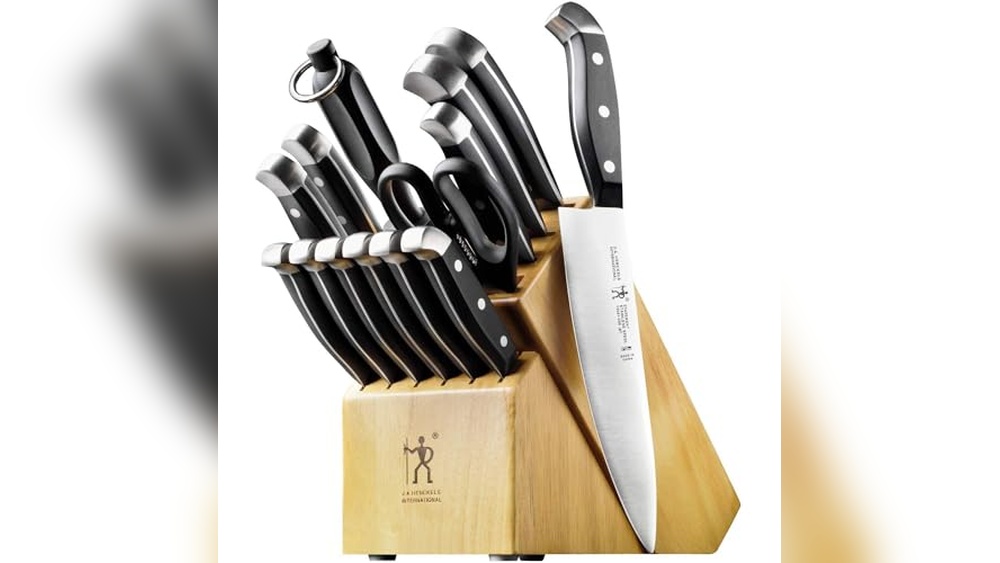
Knife blocks make it look like you need a dozen blades. You don’t. Knowing what each type of kitchen knife is for helps you buy fewer, better knives and keep them sharp.
This page is our hub for everything knives: types and uses, Western vs Japanese styles, sharpening, cutting boards and care. You can also browse every guide in our knives and cutting boards section, and for the rest of your drawer, see our cooking utensils names guide.
In this guide
Types of knives and what they are for
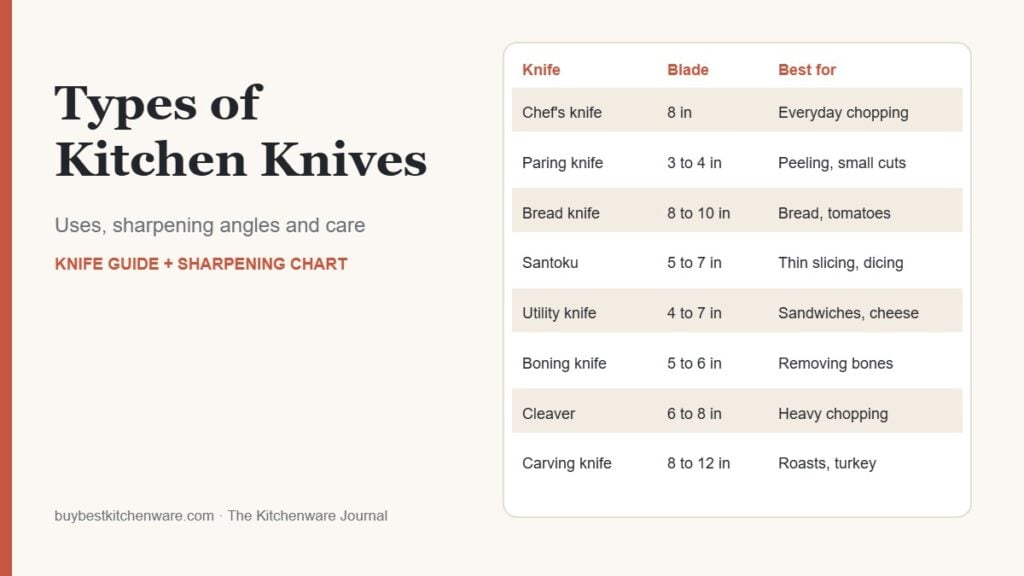
| Knife | Blade length | Best for |
|---|---|---|
| Chef’s knife | 6 to 10 in (8 in most common) | Chopping, slicing, dicing and mincing almost anything |
| Paring knife | 3 to 4 in | Peeling, trimming, coring and small, precise cuts |
| Serrated bread knife | 8 to 10 in | Crusty bread, tomatoes, cakes, anything with a tough outside and soft inside |
| Santoku | 5 to 7 in | Thin slicing and dicing; a Japanese alternative to the chef’s knife |
| Nakiri | 5 to 7 in | Straight-edged Japanese vegetable knife for crisp push-cuts with no rocking |
| Utility knife | 4 to 7 in | Sandwiches, cheese, small vegetables; in between a chef’s and a paring knife |
| Boning knife | 5 to 6 in | Separating meat from bone; flexible versions for fish |
| Carving or slicing knife | 8 to 12 in | Long, even slices of roasts, ham and turkey |
Two more you’ll see in knife blocks. A cleaver (6 to 8 in) comes in two very different styles: a heavy meat cleaver with a thick spine chops through bone and squash, while a thin Chinese cleaver (caidao) looks similar from the side but is strictly for slicing vegetables and boneless meat, never bone. A steak knife (4 to 6 in) cuts cooked meat at the table; our table setting guide shows where it goes.
Want more depth on the main workhorse? Read what a chef knife is used for and our guide to chef knife shapes. For table knives, see the best steak knives.
How to hold a chef’s knife safely
- Use the pinch grip: don’t grip far back on the handle like a hammer or rest your index finger on the spine. Pinch the flat sides of the blade just ahead of the handle between your thumb and the side of your curled index finger, and wrap your other three fingers around the handle.
- Curl your guiding hand into a claw: tuck your fingertips back and let the flat of the blade glide lightly against your middle knuckles, so the edge can never reach your fingertips.
Western vs Japanese knives
Western (German-style) knives use slightly softer steel and a thicker edge, so they shrug off rough use and are easy to sharpen. Japanese knives use harder steel ground to a thinner edge that cuts more cleanly but chips more easily. Our guide to German knives covers the Western side; for Japanese blades, see sharpening a Miyabi and sharpening Shun knives.
| Feature | Western (German-style) knives | Japanese-style knives |
|---|---|---|
| Steel hardness (HRC) | Softer, about 55–58 | Harder, about 60–63 |
| Sharpening angle | About 20° per side (modern German about 15–20°) | About 12–15° per side (some single-bevel) |
| Edge durability | Tough; rolls rather than chips | Holds an edge longer; can chip on bone or frozen food |
| Profile and motion | Curved belly for rock-chopping | Flatter edge for push and pull cuts |
| Weight and bolster | Heavier; often forged with a bolster | Lighter, thinner, nimbler |
| Best honing tool | Steel or ceramic honing rod | Ceramic rod or leather strop (no grooved steel) |
How to sharpen kitchen knives
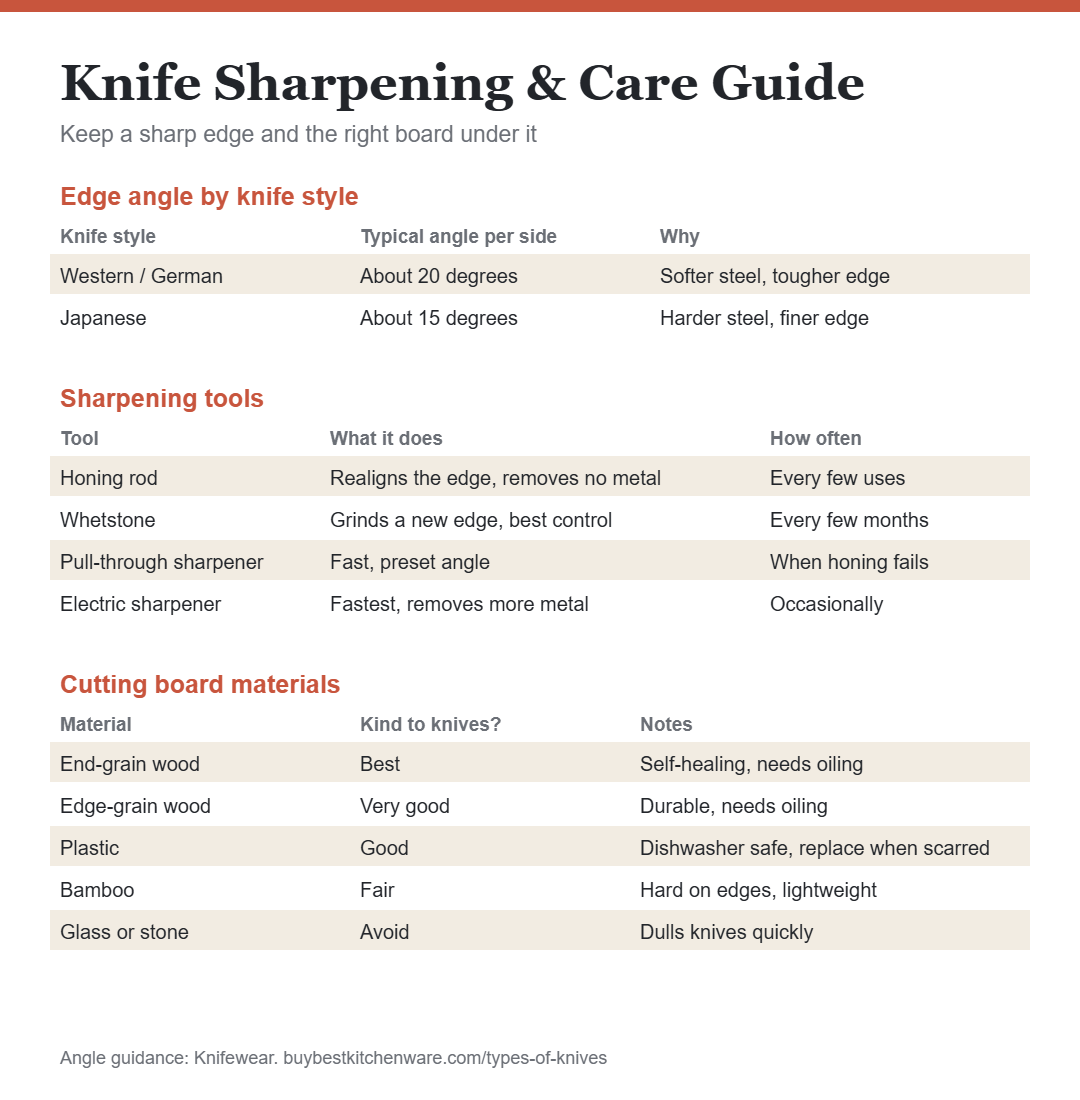
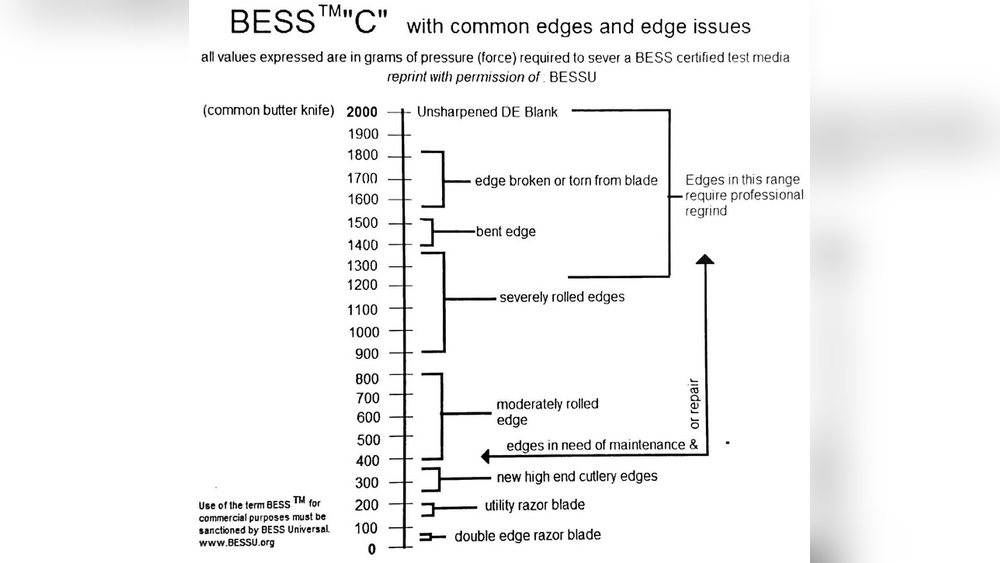
Sharpening and honing are different jobs. Honing pushes a bent edge back into line and removes almost no metal; do it every few uses. Sharpening grinds away metal to create a new edge; most home knives need it every few months. If honing no longer restores the bite, it is time to sharpen. Test with our knife sharpness chart.
The 3-second sharpness test
Two quick checks tell you whether to hone or sharpen:
- Tomato skin test: lay the blade on a ripe tomato and pull back with almost no downward pressure. If it bites into the flesh, the knife is sharp; if it slides off the skin, hone it first.
- Printer paper test: hold a sheet of paper upright and slice down at a slight angle from heel to tip. A sharp knife glides through cleanly; snags point to dull spots or tiny chips that need the 1000-grit side of a whetstone.
Sharpening angle
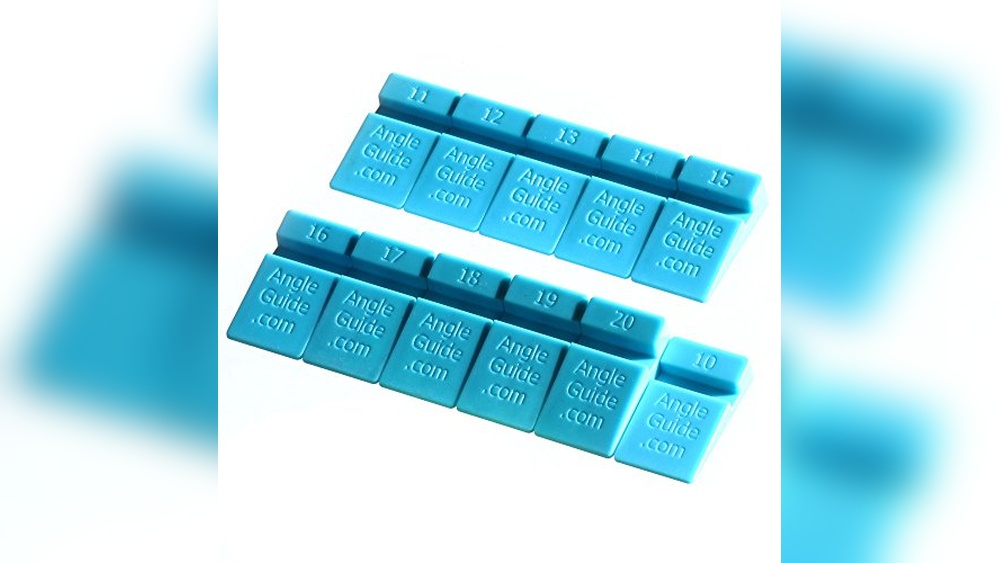
Western knives are usually sharpened at about 20 degrees per side and Japanese knives at about 15 degrees, a common rule of thumb in knife sharpening. Match the angle the knife came with. More detail: knife sharpening angle guide, Japanese knife angles and how to make an angle guide.
Sharpening tools compared
- Whetstone: the most control and the best edge. A 1000-grit side sharpens and a 6000-grit side polishes. Start with what is a whetstone, large sharpening stones and diamond plates vs stones.
- Honing rod: steel or ceramic, used between sharpenings. See honing rod vs sharpening rod, steel vs ceramic rods, sharpening steel vs whetstone and how to sharpen with a rod.
- Pull-through and electric sharpeners: fast and foolproof, but they remove more metal. Guides: coarse vs fine slots, 4-in-1 sharpeners, Henckels, Wusthof, Work Sharp and Chef’sChoice.
- In a pinch: sharpening a blunt knife, with sandpaper or a DIY sharpener.
Brand-specific guides: Cutco and Benchmade.
Cutting boards
The board matters almost as much as the sharpener: a hard surface dulls an edge in a few strokes. Wood and plastic are kind to knives; glass, stone and ceramic are not.
- End-grain wood is the gentlest on edges because the fibers part and close around the blade. Compare in end grain vs edge grain and the best wood for a cutting board.
- Plastic goes in the dishwasher; replace it when deeply scarred. Silicone and composite options: silicone boards, wood fiber boards and wheat straw boards.
- Butcher block: butcher block vs cutting board and butcher block countertops with white cabinets.
- Make your own: how to make a cutting board, a wooden chopping board, a 3D cutting board or a noodle board.
- Serving boards: the best charcuterie boards.
Caring for all types of kitchen knives
- Hand wash and dry right away; dishwashers knock edges against other items. Our kitchen cleaning checklist builds this into the nightly reset.
- Store knives in a block, on a magnetic strip or in edge guards, not loose in a drawer. See our Brookstone knife block review.
- Cut on wood or plastic, never glass, stone or plates.
- Hone often and sharpen when honing stops helping.
A simple, sharp starter kit
Skip the 15-piece block. These four pieces give you a good knife, a way to keep it sharp and a solid board, and we used them together for 14 days of daily prep to see whether a small kit really covers a home kitchen. It did. Pair it with a good skillet from our types of cookware guide and you’re ready to cook.
Our lab results
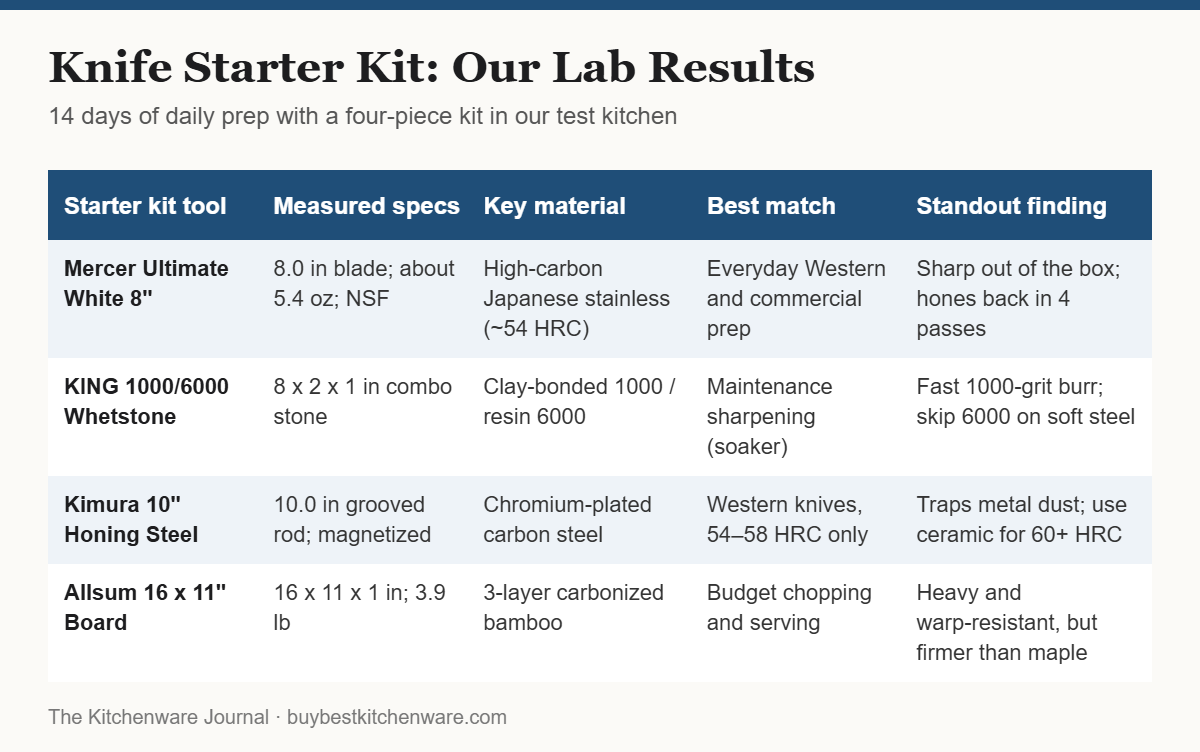
| Starter kit tool | Measured specs | Key material | Best match | Standout lab finding |
|---|---|---|---|---|
| Mercer Ultimate White 8″ | 8.0 in blade; about 5.4 oz; NSF | High-carbon Japanese stainless (~54 HRC) | Everyday Western and commercial prep | Sharp out of the box; hones back in 4 passes |
| KING 1000/6000 Whetstone | 8 x 2 x 1 in combo stone | Clay-bonded 1000 / resin 6000 | Maintenance sharpening (soaking stone) | Fast 1000-grit burr; skip 6000 on soft steel |
| Kimura 10″ Honing Steel | 10.0 in grooved rod; magnetized | Chromium-plated carbon steel | Western knives, 54–58 HRC only | Traps metal dust; use ceramic for 60+ HRC |
| Allsum 16 x 11″ Board | 16 x 11 x 1 in; 3.9 lb | 3-layer carbonized bamboo | Budget chopping and serving | Heavy and warp-resistant, but firmer than maple |
1. Mercer Culinary Ultimate White 8-Inch Chef’s Knife (Best Starter Chef’s Knife)

Start with the same 8-inch chef’s knife you’ll find in culinary schools and restaurant prep lines. It’s stamped from high-carbon Japanese stainless steel, made in Taiwan and NSF-certified, and this lightweight workhorse arrives sharp, resists rust and takes its edge back in seconds on a honing steel.
How We Tested
We used it for 14 days of daily prep: dicing 5 pounds of onions, slicing ripe Roma tomatoes and breaking down dense squash, with paper tests after 100 strokes.
What We Found
- The hollow-ground blade went through onions and ripe tomato skins cleanly.
- The textured finger points on the handle stayed locked in our grip, even with wet hands.
- After a week of chopping, 4 honing passes brought the edge right back.
Flaws to Know
- The stamped blade has less heel height and heft than a forged German knife.
- The softer commercial steel (about 54 HRC) needs a quick hone every few meals.
- Hand-wash and dry it right away.
Buy it if: you want a durable, culinary-school workhorse you won’t have to baby. Skip it if: you prefer the weight and polish of a forged knife with a bolster.
What Others Are Saying
Owners call it extremely sharp and durable, say it holds its edge and doesn’t chip easily, and like the textured grip, balance and how easily it sharpens. It’s a #1 Best Seller with 4.6 stars from more than 3,000 ratings.
Key Specs
- Blade: 8 in
- Steel: high-carbon Japanese stainless
- Handle: textured polypropylene
- NSF certified; hand wash
2. KING 1000/6000 Combination Whetstone Starter Set (Best First Whetstone)

Made in Japan, the KING 1000/6000 combination stone has taught more home cooks to sharpen freehand than almost any other. The reddish-brown 1000-grit side handles routine sharpening and raises an easy-to-feel burr quickly; the cream 6000-grit side polishes harder blades to a mirror finish. The kit adds a non-slip base, a clip-on angle guide and a drying cloth.
How We Tested
We deliberately dulled the Mercer on an unglazed ceramic rim, soaked the 1000-grit side and timed how long it took to slice printer paper cleanly again.
What We Found
- After a 12-minute soak in cool water, the 1000-grit side restored a dull chef’s knife to slicing paper in under 6 minutes.
- On a softer knife like the Mercer, stopping at 1000 grit gave the best tomato-slicing bite.
- Save the 6000-grit side for harder Japanese blades (60+ HRC).
Flaws to Know
- The soft 1000-grit side wears faster than splash-and-go ceramic stones, so use the full length and flatten it now and then.
- Don’t soak the 6000-grit side for long; just splash it.
- If you use the angle clip, put painter’s tape on the spine so stray grit doesn’t scratch the steel.
Buy it if: you want an authentic Japanese stone to learn freehand sharpening. Skip it if: you need to repair chipped blades fast (add a 300–400 grit stone first).
What Others Are Saying
Owners call it a great starter set that produces very sharp edges and is easy to use. Durability gets mixed reports, with a few cracked stones, and several mention the instructions are in Japanese. It holds 4.4 stars from about 700 ratings.
Key Specs
- Grits: 1000 (sharpen) / 6000 (polish)
- Type: water-soaking stone
- Includes: base, angle clip, cloth
- Made in Japan
3. Kimura 10-Inch Carbon Steel Honing Steel (Best Honing Rod)
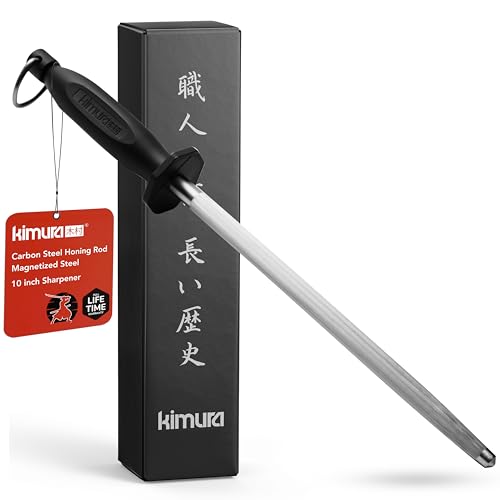
A honing rod should be at least 2 inches longer than your chef’s knife so you can run the whole edge in one smooth stroke. Kimura’s 10-inch full-tang rod pairs fine chromium-plated grooves with a magnetized core that holds tiny steel filings on the rod until you wipe them off.
How We Tested
We honed the Mercer after a week of daily chopping, using light passes at 15 to 20 degrees, and checked the edge on ripe tomatoes.
What We Found
- Four light passes per side brought the Mercer back to clean tomato slicing.
- The magnetized core held the metal dust instead of dropping it on the board.
- The contoured handle felt balanced and has a hanging loop.
Flaws to Know
- Grooved steel rods suit softer Western knives (54–58 HRC). For hard Japanese knives (60+ HRC) such as Shun or Miyabi, use a smooth ceramic rod so the grooves don’t chip the thin edge.
- Wipe it dry after washing to protect the carbon steel.
Buy it if: you want a magnetized, full-length rod for everyday Western knives. Skip it if: you mainly use hard, brittle Japanese steel.
What Others Are Saying
Owners say it keeps knives sharp and is comfortable, sturdy and light enough for longer sessions, and they consider it good value. It’s a #1 Best Seller with 4.6 stars from more than 1,200 ratings.
Key Specs
- Length: 10 in grooved rod
- Material: magnetized chromium-plated carbon steel
- Handle: full-tang polypropylene
- Care: hand wash and dry
4. Allsum 16 x 11-Inch Reversible Carbonized Bamboo Board (Best Budget Thick Board)
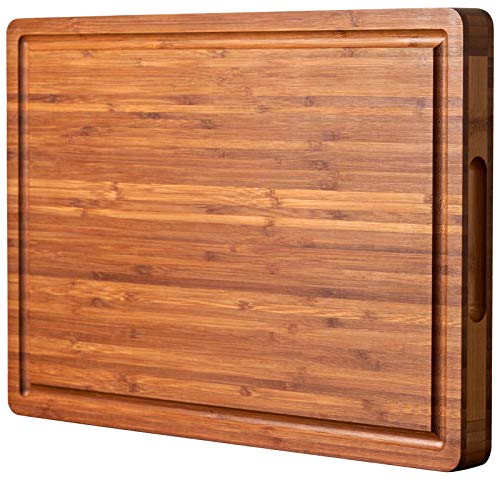
At a full inch thick and 3.9 pounds, this three-layer carbonized bamboo board sits firmly on the counter. One side has a deep juice groove for carving roasts; flip it for a flat prep surface or serving platter with recessed side handles.
How We Tested
We diced onions and stacked herbs on it with the 8-inch Mercer for 14 days and washed it repeatedly to check for warping.
What We Found
- The cross-laminated build didn’t warp after repeated washing.
- The 16 x 11-inch surface gave an 8-inch chef’s knife plenty of room.
- It’s heavy enough that it never slid while we chopped.
Flaws to Know
- Bamboo is a dense grass with more natural silica than maple, walnut or cherry. It’s far kinder to an edge than glass, stone or ceramic, but you’ll hone a little more often than on an end-grain maple block.
- Hand-wash only, and rub with food-grade mineral oil once a month.
Buy it if: you want a thick, warp-resistant, reversible board with a juice groove on a budget. Skip it if: you own delicate 62 HRC Japanese knives and want the softest end-grain maple or walnut.
What Others Are Saying
Owners like the size, thickness and weight, find it easy to clean and say it works well for charcuterie and whole chickens. Durability gets mixed feedback, with some reporting bamboo strips peeling. It holds 4.4 stars from more than 5,000 ratings.
Key Specs
- Size: 16 x 11 x 1 in
- Weight: 3.9 lb
- Material: 3-layer carbonized bamboo
- Reversible: juice groove + flat side
Notes for the UK, Canada and EU
In the UK, carrying a sharp knife in public without good reason is restricted, and buying kitchen knives online requires age verification on delivery; Amazon UK handles this at the door. Blade lengths are often listed in centimeters (a 20 cm chef’s knife is about 8 inches). European brands like Wüsthof and Zwilling use similar Western angles, while Japanese knives sold in Europe keep their sharper edges. Canadian buyers see the same brands and sizes as the US.
Frequently Asked Questions
What are the 3 most important kitchen knives?
Of all the types of kitchen knives, the three that matter most are a chef’s knife, a paring knife and a serrated bread knife. Together they handle almost every cutting job.
How often should I sharpen my kitchen knives?
Hone every few uses and sharpen every few months for typical home cooking, or sooner if the knife slips on a tomato skin.
What angle should I sharpen my knife at?
About 20 degrees per side for Western knives and about 15 degrees for Japanese knives. Follow the manufacturer if it states an angle.
Is a santoku better than a chef’s knife?
Neither is better. A santoku is shorter, flatter and suits push-cutting; a chef’s knife has a curved belly for rocking cuts. Pick the one that feels right in your hand.
How many kitchen knives do I really need?
Three: a chef’s knife, a paring knife and a serrated bread knife. Add a honing rod to keep them sharp.
Can I use a steel honing rod on Japanese knives?
No. Grooved steel honing rods are meant for softer Western blades (54–58 HRC). Hard Japanese steel (60+ HRC) is thinner and more brittle, so a grooved rod can chip the edge. Use a smooth ceramic rod or a leather strop instead.

Reviewed by Samantha Hickel, Kitchenware Reviewer & Cookware Expert. Samantha has cooked for more than ten years, has reviewed kitchenware for The Kitchenware Journal since 2022, and covers stock pots, saucepans, canning, cake and bread pans, cutting boards and everyday kitchen tools. Our lab tests kitchen knives, sharpeners and cutting boards for out-of-box sharpness, edge retention, handle balance and board surface wear. How we test.